

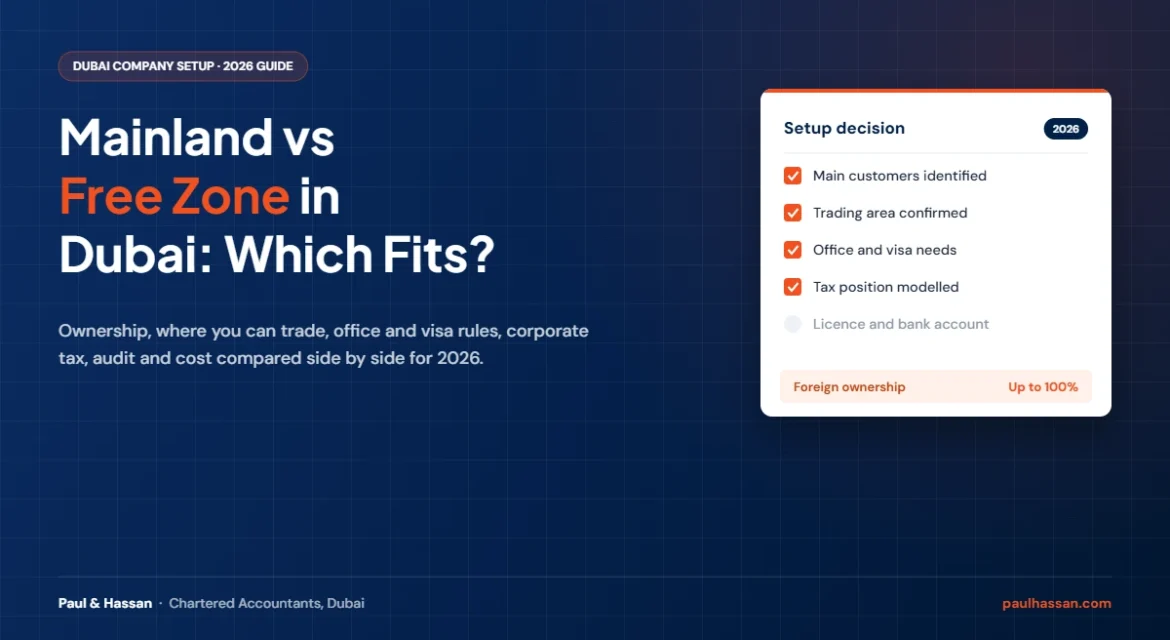
Mainland vs free zone Dubai, compared clearly for 2026: ownership, where you can trade, office and visa rules, corporate tax and the 0% free zone regime, audit duties, costs and a practical decision guide for founders.
The first big decision when you set up a company in Dubai is where to license it. A mainland company is licensed by the Dubai Department of Economy and Tourism and can trade anywhere in the UAE. A free zone company is licensed by one of more than 20 free zone authorities in Dubai and offers fast setup, flexible offices and a possible 0% corporate tax rate. Both now allow 100% foreign ownership for most activities.
This guide compares mainland vs free zone Dubai options on the points that actually change your business: where you can sell, office and visa rules, corporate tax, audit and compliance, banking and cost. It ends with a simple decision guide based on the questions we ask founders every week at Paul & Hassan.
Key takeaways: mainland vs free zone Dubai
- Both mainland and free zone companies can be 100% foreign owned for most activities.
- A mainland company can trade directly across the UAE and bid for government contracts. A free zone company trades freely within its zone and abroad, and needs a permit, distributor or mainland entity for most mainland business.
- Both pay 9% corporate tax on profits above AED 375,000, but a free zone company can pay 0% on qualifying income as a qualifying free zone person.
- Mainland companies need a physical office with Ejari. Free zones offer flexi desks, but visa numbers depend on space.
- Choose based on who your customers are and where you will sell, then model the tax and running costs.
Table of Contents
Mainland vs Free Zone Dubai: Side by Side
| Factor | Mainland company | Free zone company |
|---|---|---|
| Licensing authority | Department of Economy and Tourism (DET) | The individual free zone authority, such as DMCC, DAFZA, JAFZA or Meydan |
| Foreign ownership | Up to 100% for most activities, some strategic activities restricted | 100% |
| Where you can trade | Anywhere in the UAE and abroad | Within the zone and abroad; mainland trade usually through a permit, distributor or mainland entity |
| Government contracts | Can bid directly | Generally not without a mainland presence |
| Office | Physical office with Ejari required | Flexi desk, shared or dedicated office options |
| Visas | Linked to office size | Linked to the package and space leased |
| Corporate tax | 9% above AED 375,000, Small Business Relief available | 0% on qualifying income if a qualifying free zone person, otherwise 9% |
| Customs | Duties apply on imports | Duty suspended within the zone; duty due when goods enter the mainland |
| Annual audit | Required for LLCs under company law | Required by most free zones for licence renewal |
There is no universally better option
A free zone suits an international trading or holding business. A mainland licence suits a business that serves UAE customers directly. Many groups use both.
Ownership and Business Activities
Amendments to the Commercial Companies Law that took effect in 2021 removed the general requirement for a UAE national shareholder in mainland companies. Today most commercial and professional activities can be 100% foreign owned on the mainland, while a short list of activities with strategic impact, such as certain energy, security and utilities activities, keeps special conditions.
On ownership, the mainland vs free zone Dubai gap has closed, as free zones have always allowed full foreign ownership. Each free zone publishes its own list of permitted activities, so the right zone depends on what you do. Media businesses gravitate to media zones, commodity traders to DMCC, logistics companies to JAFZA or Dubai South, and financial firms to the DIFC.
Where You Can Trade
In the mainland vs free zone Dubai decision, this is the deciding factor for most businesses. A mainland company can sell goods and services to any customer in the UAE, open shops and branches anywhere in Dubai, and bid for government work.
A free zone company can trade within its own zone, with other free zones and internationally. To serve mainland customers it traditionally needed a local distributor or a separate mainland licence. Since 2025, Dubai has allowed free zone companies to apply to the Department of Economy and Tourism for a permit to carry out certain activities in mainland Dubai without forming a new company, subject to approval and conditions.
| Your main customers | Better fit |
|---|---|
| UAE consumers, shops or restaurants | Mainland |
| UAE government and semi government entities | Mainland |
| Customers mostly outside the UAE | Free zone |
| Other free zone companies | Free zone |
| Group holding of shares or investments | Free zone |
| A mix of UAE and international clients | Mainland, or free zone plus a mainland permit or branch |
Office, Visas and Running Costs
Mainland companies must lease a physical office registered with Ejari. Virtual offices are not accepted for most activities, and the number of employment visas depends on the size of the premises. Free zones offer packages from flexi desks to warehouses, which keeps early costs low, although visa allocations still grow with the space you take.
In any mainland vs free zone Dubai comparison, costs vary widely by activity, number of visas and office choice, so compare total annual costs rather than headline licence fees. The main components are:
- Licence and registration fees, paid every year at renewal
- Office rent, Ejari or the free zone lease
- Establishment card, immigration and labour fees
- Visa costs for each investor and employee, including medical tests and Emirates ID
- Approvals from other authorities for regulated activities
- Accounting, VAT, corporate tax and annual audit fees
- Bank account maintenance and minimum balance requirements
Our PRO services and visa services handle government transactions for both mainland and free zone companies once you are set up.
Corporate Tax: Mainland vs Free Zone Dubai Compared
Corporate tax applies to both sides of the mainland vs free zone Dubai choice. The difference is the special regime available only in free zones.
| Tax point | Mainland company | Free zone company |
|---|---|---|
| Standard rates | 0% up to AED 375,000, 9% above | Same, unless a qualifying free zone person |
| Free zone regime | Not available | 0% on qualifying income, 9% on other income, if all conditions are met |
| Small Business Relief | Available if revenue is AED 3 million or less | Available only if not a qualifying free zone person |
| Audited financial statements for tax | Required if revenue exceeds AED 50 million | Required for every qualifying free zone person |
| Transfer pricing | Applies to related party transactions | Applies, and is a condition of the 0% rate |
The 0% free zone rate is valuable but demanding. It requires real substance, qualifying income and an annual audit, and one failure costs five years at 9%. Read our full guide to the qualifying free zone person rules, and our guide to Small Business Relief for the relief available to smaller mainland businesses.
Model the tax before you choose
A free zone company selling mostly to mainland customers often ends up paying 9% anyway. In that case the mainland licence may be the simpler and cheaper route.
Audit, VAT and Ongoing Compliance
Whichever side of the mainland vs free zone Dubai choice you take, the compliance calendar is similar. VAT registration is required once taxable supplies exceed AED 375,000, corporate tax registration and annual returns apply to every company, and economic substance, UBO and anti money laundering rules apply according to your activities.
- Mainland LLCs must keep accounting records and prepare audited financial statements each year under the Commercial Companies Law.
- Most free zones require audited financial statements to renew the licence, whatever the company size.
- Every company must maintain a register of ultimate beneficial owners and keep records for the required periods.
- Designated Zones have special VAT treatment for goods moving within and between them.
Our audit services in Dubai cover both mainland and free zone companies, and our VAT registration guide explains the thresholds in detail.
Mainland vs Free Zone Dubai: How to Decide in 6 Steps
- 01
Identify your main customers
List where your customers are based and whether they are businesses, consumers or government bodies.
- 02
Confirm where the work will be done
Note whether you need a shop, site work, a warehouse or simply an office, and in which emirate.
- 03
Check the activity rules
Confirm your activity is permitted, and whether it needs approvals, in the mainland and your preferred free zones.
- 04
Estimate visas and space
Decide how many visas you need in the first two years and the space that supports them.
- 05
Model tax and running costs
Compare licence, office, visa, accounting and tax costs for three years under each option, including the 0% regime conditions.
- 06
Plan banking and substance
Banks will ask where decisions are made and where staff sit. Choose a structure you can evidence.
1. Choosing a free zone only for 0% tax
If most income comes from mainland customers, the 0% rate may never apply.
2. Underestimating visa needs
A flexi desk may not support the visas you need in year two.
3. Ignoring activity approvals
Some activities need external approvals that add time and cost.
4. Forgetting annual audit and tax costs
Compliance fees are part of the running cost of both structures.
5. Opening without a banking plan
Banks expect substance and clear business activity before opening an account.
If you already know which way you are leaning, see our mainland company setup and free zone company setup services. For businesses that only hold assets or trade outside the UAE, an offshore company can also be an option.
Not sure whether mainland or free zone suits your business?
Our company formation and tax team in Al Karama, Dubai compares both options for your activity, models the tax and running costs, and handles licensing, visas, bank account support and registrations from start to finish.
Frequently Asked Questions
Answers to the questions founders ask us most when choosing between a mainland and a free zone company in Dubai, grouped in two parts.
Part 1 Ownership, Trading and Setup
Can foreigners own 100% of a mainland company in Dubai?
Yes. Since the 2021 amendments to the Commercial Companies Law, most mainland activities allow 100% foreign ownership, with special conditions for a small number of strategic activities.
Can a free zone company trade with mainland customers?
A free zone company can trade freely within its zone and abroad. For most mainland business it needs a local distributor, a mainland branch or company, or a permit from the Department of Economy and Tourism where available.
Which is faster to set up, mainland or free zone?
Free zone companies are often licensed within a few days to two weeks. Mainland setup can take a little longer because of office leasing and any external approvals.
Do I need a physical office for a mainland company?
Yes. Mainland companies generally need a physical office with a registered Ejari tenancy contract.
Can a free zone company bid for government contracts?
Generally not directly. Government tenders usually require a mainland licence or a mainland presence.
Which free zone is best in Dubai?
It depends on your activity. Commodity traders often choose DMCC, logistics firms JAFZA or Dubai South, media businesses media zones and financial firms the DIFC. Cost and visa needs also matter.
Part 2 Tax, Audit and Compliance
Do free zone companies pay corporate tax?
Yes, they are subject to corporate tax. A qualifying free zone person pays 0% on qualifying income and 9% on other income. Other free zone companies pay the standard rates.
Is a mainland company always taxed at 9%?
No. Taxable income up to AED 375,000 is taxed at 0% and only the excess at 9%. Small businesses with revenue of AED 3 million or less can elect Small Business Relief.
Do both mainland and free zone companies need an audit?
Mainland LLCs need audited financial statements under company law, and most free zones require an audit to renew the licence. Corporate tax also requires audits in specific cases.
Is VAT different for free zone companies?
VAT generally applies in the same way. Designated Zones have special rules for goods moving within and between them.
Can I convert a free zone company to mainland later?
Options exist to add a mainland branch or permit, and frameworks introduced in 2025 allow some companies to move registration between a free zone and the mainland, subject to approvals.
Can one owner have both a mainland and a free zone company?
Yes. Many groups use a free zone company for international trade or holding and a mainland company for UAE customers, with transfer pricing applied to transactions between them.
Official sources: business setup information on the UAE Government portal, corporate tax guidance from the Federal Tax Authority and the Commercial Companies Law on the UAE Legislation portal.
This article is general information based on UAE company and tax rules as of November 2026 and is not legal or tax advice for your specific situation. Licensing rules, fees and approvals change and vary by activity and free zone, so confirm current requirements with the relevant authority or speak to a qualified adviser.