

Everything owners need to know about Small Business Relief in the UAE: the AED 3 million revenue test, the extension to tax periods ending by 31 December 2029, how to elect it in your return, worked examples and the trade offs.
For thousands of small companies and freelancers in the UAE, Small Business Relief is the single most valuable corporate tax rule. If your revenue stays at or below AED 3 million, you can elect to be treated as having no taxable income, which means no corporate tax to pay, simpler records and a lighter return.
The relief was due to end with tax periods finishing on 31 December 2026. The Ministry of Finance has now extended it to tax periods ending on or before 31 December 2029. This guide explains who qualifies for small business relief UAE rules, how revenue is measured, how to claim it on EmaraTax, what you give up when you elect it and how to decide whether it is right for your business.
Key takeaways on small business relief UAE rules
- Resident taxable persons with revenue of AED 3 million or less in the current and every previous tax period can elect Small Business Relief.
- The relief now covers tax periods that end on or before 31 December 2029, following Ministerial Decision No. 131 of 2026.
- Electing means you are treated as having no taxable income for that period, so no corporate tax is payable.
- You must still register for corporate tax, keep records and file a return within 9 months of your year end, and the election is made in that return.
- Qualifying free zone persons and members of large multinational groups are excluded, and losses from relief periods cannot be carried forward.
Table of Contents
Small Business Relief UAE: What It Is and How It Works
Small business relief UAE rules (SBR) set out an optional relief under Article 21 of the Corporate Tax Law (Federal Decree-Law No. 47 of 2022). Ministerial Decision No. 73 of 2023 sets the revenue threshold and the time limit, and Ministerial Decision No. 131 of 2026 extended that time limit.
When an eligible business elects the relief for a tax period, it is treated as having derived no taxable income for that period. Whatever the actual profit, corporate tax payable is nil. The relief is designed to reduce the cost of compliance for small companies, start ups and individuals in business.
| Item | What applies in 2026 |
|---|---|
| Legal basis | Article 21 of Federal Decree-Law No. 47 of 2022, Ministerial Decision No. 73 of 2023 as amended |
| Revenue threshold | AED 3,000,000 per tax period |
| Periods covered | Tax periods starting on or after 1 June 2023 and ending on or before 31 December 2029 |
| Effect of electing | Treated as having no taxable income for that period |
| How to claim | Election made in the corporate tax return on EmaraTax |
| Excluded | Qualifying free zone persons and members of multinational groups with consolidated revenue of AED 3.15 billion or more |
Who Qualifies Under Small Business Relief UAE Rules?
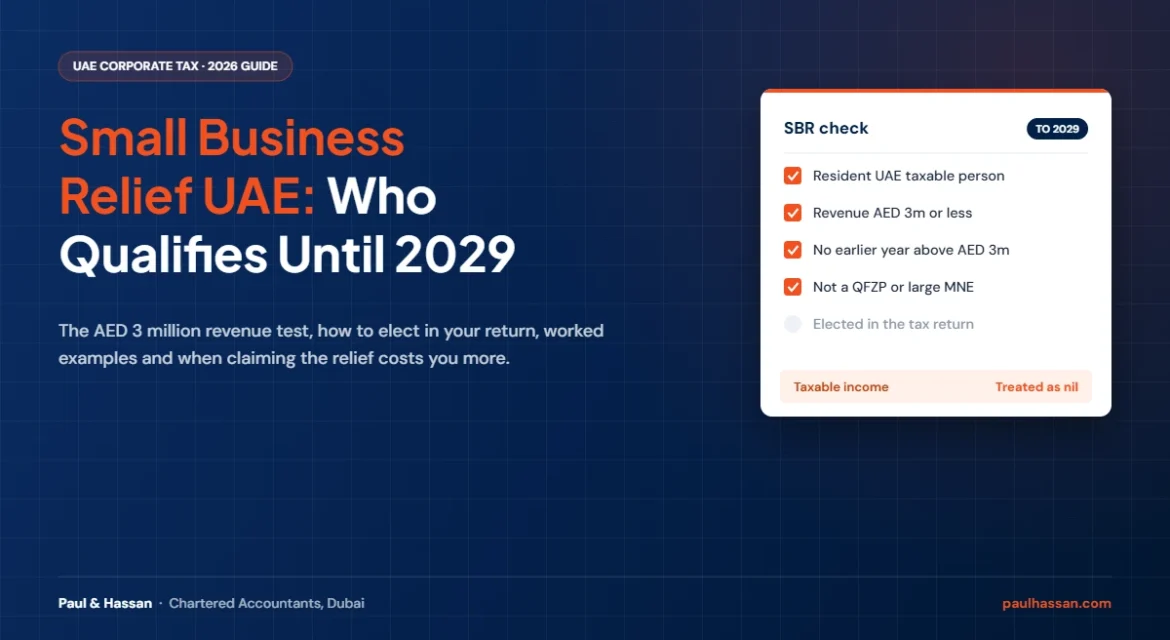
Under small business relief UAE rules, you can elect the relief for a tax period if all of the following are true:
- You are a resident person, such as a UAE company, a foreign company effectively managed in the UAE, or an individual carrying on business in the UAE.
- Revenue in the tax period is AED 3 million or less.
- Revenue in every previous tax period was also AED 3 million or less. Once you exceed the threshold in any period, the relief is closed for later periods.
- You are not a qualifying free zone person.
- You are not a constituent company of a multinational enterprise group with consolidated group revenue of AED 3.15 billion or more.
Free zone companies that do not meet the qualifying free zone person conditions are treated like mainland companies and can elect the relief if their revenue qualifies. If you are weighing the free zone regime against the relief, our guide to the qualifying free zone person rules explains the trade off.
Individuals in business
A natural person must register for corporate tax once turnover from business activities in the UAE exceeds AED 1 million in a calendar year. Most freelancers and sole traders between AED 1 million and AED 3 million can then use Small Business Relief.
How Revenue Is Measured for the AED 3 Million Test
Revenue means the gross amount of income derived in the tax period, determined under the accounting standards accepted in the UAE. It is revenue, not profit. A company with AED 3.4 million of sales and a loss still fails the test.
The small business relief UAE test looks at each tax period on its own and at every period before it. That makes the first year above AED 3 million a permanent turning point for the business.
| Tax period | Revenue | Relief available? |
|---|---|---|
| Year ending 31 December 2024 | AED 1,900,000 | Yes |
| Year ending 31 December 2025 | AED 2,750,000 | Yes |
| Year ending 31 December 2026 | AED 3,200,000 | No, threshold exceeded |
| Year ending 31 December 2027 | AED 2,600,000 | No, an earlier period exceeded AED 3 million |
The Federal Tax Authority can also treat businesses that are artificially split to keep each part below AED 3 million as one business. Dividing one operation into several licences with the same owners and customers is the type of arrangement the anti abuse rule targets.
Worked Example: What the Relief Saves
Consider a Dubai consultancy with revenue of AED 2,800,000 and a taxable profit of AED 900,000 for the year ending 31 December 2026.
| Without the relief | With Small Business Relief | |
|---|---|---|
| Taxable income | AED 900,000 | Treated as nil |
| First AED 375,000 at 0% | AED 0 | Not applicable |
| Remaining AED 525,000 at 9% | AED 47,250 | Not applicable |
| Corporate tax payable | AED 47,250 | AED 0 |
Small business relief UAE rules save this company AED 47,250 for one year. Over the remaining relief periods to 2029, a business with steady results could save several times that amount, as long as revenue never crosses AED 3 million.
How to Claim Small Business Relief on EmaraTax
There is no separate application for small business relief UAE claims. You make the election each year when you file the corporate tax return.
- 01
Register for corporate tax
Every eligible business must hold a corporate tax registration number before it can file and elect the relief. Late registration carries a penalty of AED 10,000.
- 02
Close the books for the tax period
Prepare financial statements and confirm total revenue for the period. Businesses with revenue below AED 3 million may prepare accounts on a cash basis.
- 03
Check every previous tax period
Confirm that revenue in all earlier tax periods was also AED 3 million or less.
- 04
Open the corporate tax return on EmaraTax
Select the tax period from your taxable person profile and start the return before the 9 month deadline.
- 05
Elect Small Business Relief
Answer the relief question in the return and confirm the revenue figure. The return then simplifies the computation.
- 06
Submit and keep the evidence
File the return and keep accounts, invoices and bank records for at least 7 years in case the FTA asks for them.
If you are not yet registered, our corporate tax registration service completes the EmaraTax application for you. For the filing itself, see our step by step guide to corporate tax return filing in the UAE.
What You Give Up When You Elect the Relief
Small business relief UAE rules are generous, but they are not free of consequences. Before electing, consider these trade offs.
- Tax losses are not carried forward. A loss made in a period where you elect the relief cannot be used to reduce future taxable income.
- Net interest expenditure is not carried forward from relief periods.
- The relief ends permanently once revenue in any period exceeds AED 3 million, so planning for growth matters.
- Filing still applies. The relief removes tax, not the obligation to register, keep records and file on time.
For most profitable small businesses, the relief is clearly worth electing. The decision is harder for start ups expecting early losses and rapid growth. If you expect to exceed AED 3 million soon, losses kept outside the relief could shelter future profits taxed at 9%, which may be worth more than a nil tax result today.
Elect year by year
The election is made for each tax period. You can elect it in a profitable year and choose not to elect it in a loss year, as long as you still meet the conditions.
Records, Accounts and Compliance Under the Relief
Small business relief UAE rules simplify corporate tax, but sound bookkeeping is still essential. The FTA can review your revenue figure, and VAT, payroll and licensing rules continue to apply.
- Keep a complete sales ledger that agrees with bank statements
- Retain tax invoices, contracts and bank records for at least 7 years
- Prepare annual financial statements, on a cash or accrual basis as permitted
- Track cumulative revenue monthly so you know when you approach AED 3 million
- Keep VAT returns consistent with the revenue reported in the corporate tax return
- Document related party sales and transactions with owners at market value
Our bookkeeping services in Dubai keep your ledger, VAT and corporate tax figures aligned throughout the year, which makes the annual election quick and safe.
Penalties Small Businesses Still Face
A nil tax result under small business relief UAE rules does not protect you from administrative penalties. The most common ones for small businesses are below.
| Failure | Penalty |
|---|---|
| Late corporate tax registration | AED 10,000 |
| Late filing of the corporate tax return | AED 500 a month for the first 12 months, then AED 1,000 a month |
| Failure to keep required records | AED 10,000 for each violation, rising to AED 20,000 for repeat violations within 24 months |
| Incorrect return corrected by voluntary disclosure | Percentage based penalty on the tax difference, depending on timing |
1. Not registering because no tax is due
Registration is mandatory for eligible companies and individuals above the business turnover threshold, even if the relief makes tax nil.
2. Confusing profit with revenue
The AED 3 million test is based on revenue. Profitable or not, sales above the threshold end the relief.
3. Forgetting earlier periods
One earlier period above AED 3 million closes the relief for good.
4. Electing in a loss year without thinking
Losses in relief periods are lost. Consider whether keeping the loss is worth more.
5. Splitting the business to stay small
Artificial separation can be challenged under the anti abuse rules.
Want us to confirm your Small Business Relief position?
Our corporate tax team in Al Karama, Dubai checks your revenue history, registers your business if needed, prepares your accounts and files the return with the right election, so you pay nothing you do not owe.
Frequently Asked Questions
Answers to the questions small business owners ask us most about Small Business Relief in the UAE, grouped in two parts.
Part 1 Eligibility and the Threshold
What is the Small Business Relief threshold in the UAE?
The threshold is revenue of AED 3 million or less in the tax period and in every previous tax period. Revenue is measured under the accounting standards accepted in the UAE.
Until when is Small Business Relief available?
Following Ministerial Decision No. 131 of 2026, the relief applies to tax periods that start on or after 1 June 2023 and end on or before 31 December 2029.
Is the AED 3 million test based on revenue or profit?
Revenue. A business with revenue above AED 3 million cannot use the relief even if it made a loss.
Can a free zone company claim Small Business Relief?
A free zone company that is not a qualifying free zone person can claim the relief if its revenue qualifies. A qualifying free zone person cannot.
Can freelancers and sole traders use the relief?
Yes. Individuals whose business turnover exceeds AED 1 million must register for corporate tax, and those with revenue of AED 3 million or less can elect the relief.
What happens if my revenue goes above AED 3 million?
You cannot claim the relief for that tax period or any later period, even if revenue falls back below AED 3 million.
Part 2 Claiming and Consequences
Do I need to register for corporate tax if I claim the relief?
Yes. Registration is required before you can file the return and make the election. Late registration carries a penalty of AED 10,000.
Do I still need to file a corporate tax return?
Yes. The election is made in the return, which is due within 9 months after the end of the tax period.
How do I elect Small Business Relief?
Answer the Small Business Relief question in the corporate tax return on EmaraTax and confirm your revenue for the period.
Can I carry forward losses while using the relief?
No. Tax losses and net interest expenditure incurred in a period for which you elect the relief cannot be carried forward.
Do I need audited financial statements to claim the relief?
Usually not. Audited statements are required for corporate tax only where revenue exceeds AED 50 million or for qualifying free zone persons, although your licensing authority may require an audit separately.
Can the FTA reject my Small Business Relief claim?
Yes, if the conditions are not met, for example where an earlier period exceeded AED 3 million or the business was artificially separated to stay below the threshold.
Official sources: the Federal Tax Authority guidance on Small Business Relief, Ministerial decisions published by the UAE Ministry of Finance and the Corporate Tax Law on the UAE Legislation portal.
This article is general information based on UAE corporate tax rules as of November 2026 and is not tax advice for your specific situation. Thresholds, deadlines and penalties can change, so confirm current requirements with the Federal Tax Authority or speak to a qualified adviser.