

A practical AML compliance UAE guide for real estate brokers, gold and jewellery dealers, corporate service providers, accountants and lawyers: the 2025 AML law, goAML registration, due diligence, sanctions screening, reporting duties and penalties.
Anti money laundering rules are no longer a concern for banks alone. In the UAE, real estate brokers, gold and jewellery traders, corporate service providers, accountants, auditors and lawyers are all designated non financial businesses and professions (DNFBPs), with legal duties to know their customers, screen them against sanctions lists and report suspicious activity. Supervisors inspect them, and the fines run into millions of dirhams.
In October 2025, a new federal AML law replaced the 2018 framework and tightened several obligations. This guide explains AML compliance UAE requirements in practical terms: who is covered, what the 2025 law changed, how to register on goAML, the core elements of a compliant programme and the penalties for getting it wrong.
Key takeaways on AML compliance UAE rules
- Federal Decree-Law No. 10 of 2025 on anti money laundering, counter terrorist financing and proliferation financing replaced Federal Decree-Law No. 20 of 2018 from 14 October 2025.
- DNFBPs include real estate brokers, dealers in precious metals and stones, corporate service providers, accountants and auditors, lawyers and notaries and commercial gaming operators.
- Every DNFBP needs a documented risk assessment, customer due diligence, sanctions screening, a compliance officer and goAML registration for reporting.
- Dealers in precious metals and stones must apply AML measures to cash transactions of AED 55,000 or more.
- Administrative fines can reach AED 5 million per violation, with possible licence suspension and criminal liability for serious breaches.
Table of Contents
Who Must Meet AML Compliance UAE Requirements?
The AML compliance UAE framework applies to financial institutions and to designated non financial businesses and professions when they carry out specified activities for clients. For DNFBPs on the mainland and in commercial free zones, the main supervisor is the Ministry of Economy and Tourism, while lawyers and notaries are supervised by the Ministry of Justice.
| DNFBP sector | When AML duties apply | Supervisor |
|---|---|---|
| Real estate brokers and agents | When involved in buying or selling property for clients | Ministry of Economy and Tourism |
| Dealers in precious metals and stones | Cash transactions of AED 55,000 or more, single or linked | Ministry of Economy and Tourism |
| Corporate and trust service providers | Forming companies, acting as nominee or director, providing registered offices | Ministry of Economy and Tourism |
| Accountants and auditors | When handling client money, managing accounts or company formation and restructuring for clients | Ministry of Economy and Tourism |
| Lawyers, notaries and legal professionals | When preparing or carrying out specified transactions for clients | Ministry of Justice |
| Commercial gaming operators | Gaming activities in the UAE | General Commercial Gaming Regulatory Authority |
Financial free zones have their own regulators
Businesses licensed in the DIFC or ADGM are supervised by the DFSA or FSRA under their own rulebooks, which follow the same federal AML principles.
What Changed Under the 2025 AML Law
Federal Decree-Law No. 10 of 2025 and its executive regulation, Cabinet Resolution No. 134 of 2025, modernised the framework rather than starting again. The changes most relevant to DNFBPs are:
- Proliferation financing is now addressed alongside money laundering and terrorist financing throughout the law.
- Stronger beneficial ownership rules, including an offence for knowingly providing false beneficial ownership information.
- A wider tipping off offence, covering disclosure that a report or investigation may take place.
- Personal accountability for compliance officers and senior management for the effectiveness of the AML programme.
- Higher penalties for administrative and criminal violations, including for unlicensed activity in regulated sectors.
If your AML compliance UAE policies were written before October 2025, they should be reviewed and updated to reflect the new law, the executive regulation and the latest supervisory guidance.
goAML Registration
goAML is the AML compliance UAE reporting platform of the UAE Financial Intelligence Unit (FIU). Every DNFBP must register on goAML so that it can file suspicious transaction reports and other required reports, and receive communications from the FIU. Registration is separate from your supervisor’s own portal used for questionnaires and self assessments.
- 01
Appoint your compliance officer
Name a UAE resident compliance officer with enough seniority and access to senior management before you register.
- 02
Register with your supervisor
Complete the supervisor registration and any required questionnaires for your sector.
- 03
Create the goAML organisation profile
Register the business on goAML with licence details, activities and the compliance officer’s information.
- 04
Upload supporting documents
Provide the trade licence, compliance officer appointment letter, IDs and other documents requested.
- 05
Activate users and test access
Once approved, set up users, confirm login access and keep credentials secure.
- 06
Record the registration
File the approval and keep evidence for supervisory inspections.
The Core Elements of AML Compliance UAE Programmes
1. Business wide risk assessment
Identify and document the money laundering, terrorist financing and proliferation financing risks your business faces, based on your customers, products, delivery channels and geographies. Senior management should approve it and it should be updated regularly.
2. Customer due diligence
Before establishing a relationship or carrying out an occasional transaction above the thresholds, verify the identity of the customer and its beneficial owners, understand the purpose of the relationship and the source of funds, and screen against sanctions lists. Apply enhanced due diligence to higher risk customers, such as politically exposed persons or customers from high risk jurisdictions.
3. Sanctions screening and targeted financial sanctions
Screen customers, beneficial owners and counterparties against the UAE local terrorist list and the UN consolidated list published by the Executive Office for Control and Non Proliferation. Where a match is confirmed, freeze funds without delay and report as required.
4. Reporting
File a suspicious transaction report on goAML promptly when you suspect funds are linked to a crime, and never inform the customer. Dealers in precious metals and stones and real estate businesses also have sector specific reporting duties for certain cash and high risk transactions.
5. Governance, records and training
Maintain written policies approved by management, appoint a compliance officer, train staff regularly, test the programme independently and keep due diligence and transaction records for at least five years.
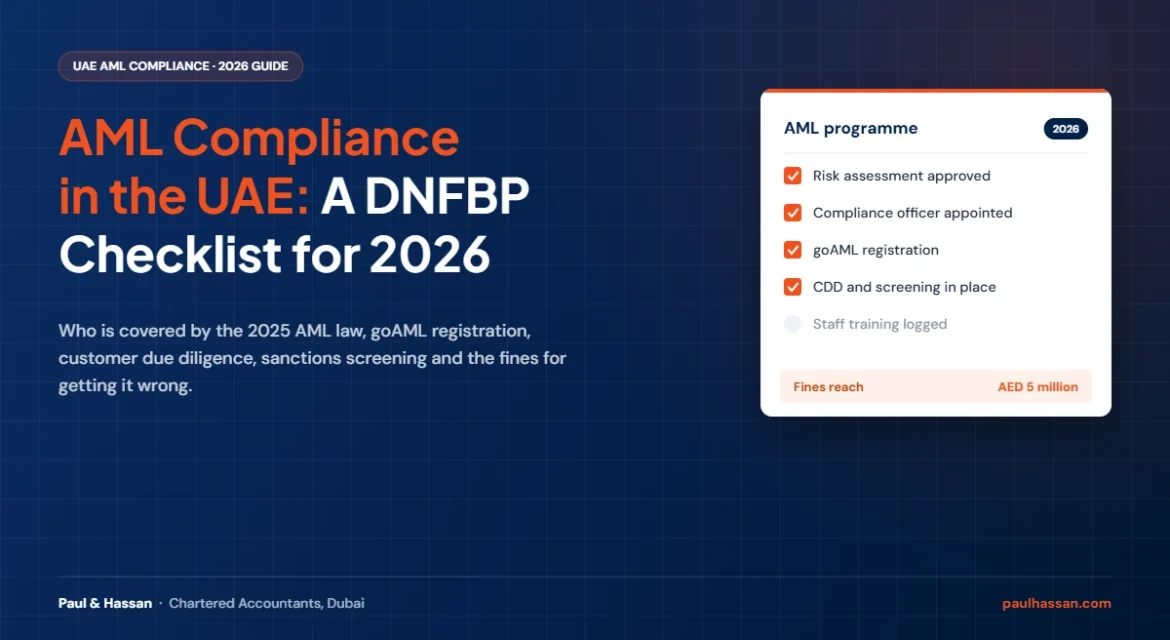
- Risk assessment documented and approved
- AML policies and procedures updated for the 2025 law
- Compliance officer appointed and registered
- goAML and supervisor portal registrations complete
- Customer due diligence and beneficial ownership checks on file
- Sanctions screening at onboarding and on list updates
- Suspicious transaction reporting process tested
- Staff training records maintained
- Records retained for at least five years
- Independent review of the programme completed
Sector Notes for Common DNFBPs
| Sector | Common risk points |
|---|---|
| Real estate | Cash or third party payments, purchases through companies with unclear ownership, rapid resale |
| Gold and jewellery | Large cash purchases, split transactions just below AED 55,000, customers unwilling to provide ID |
| Corporate service providers | Nominee arrangements, complex structures, frequent changes in ownership |
| Accountants and auditors | Handling client funds, unusual transactions in client books, requests to structure payments |
Beneficial ownership is a common thread in AML compliance UAE checks across every sector. Our UBO declaration service keeps your own register and filings in order, which supervisors check during inspections.
Penalties for AML Violations
Supervisors test AML compliance UAE programmes through on site and desk based inspections. Where they find weaknesses, they can impose administrative sanctions, and serious cases are referred for criminal prosecution.
| Consequence | What it can mean |
|---|---|
| Administrative fines | Fines per violation that can reach AED 5 million |
| Restrictions on the business | Warnings, restrictions on activity, suspension of the licence or cancellation |
| Action against individuals | Sanctions against managers and compliance officers, including bans from certain roles |
| Failure to report a suspicious transaction | Criminal liability, with imprisonment and fines |
| Tipping off a customer | A criminal offence with significant fines |
1. Treating AML as a one time project
Policies, risk assessments and training must be updated as the business and the law change.
2. Registering on goAML but never using it
Supervisors expect a working reporting process, not just an account.
3. Weak beneficial ownership checks
Accepting a company as a customer without identifying the real owners is a frequent inspection finding.
4. Screening only at onboarding
Sanctions lists change. Screening must continue during the relationship.
5. No evidence of training
Training that is not recorded is treated as training that did not happen.
AML Compliance UAE: Where to Start
If you are starting from scratch or updating an older programme, work in this order: confirm whether your activities make you a DNFBP, appoint the compliance officer, complete the risk assessment, write or refresh your policies, register on goAML and the supervisor portal, set up due diligence and screening tools, then train your team and schedule an independent review.
Our AML compliance services in Dubai cover each step, from risk assessments and policy manuals to goAML registration, outsourced compliance officer support and independent AML audits.
Need an AML programme that will stand up to inspection?
Our AML team in Al Karama, Dubai assesses your risks, writes your policies, registers you on goAML, trains your staff and carries out independent reviews, so you are ready when the supervisor calls.
Frequently Asked Questions
Answers to the questions business owners ask us most about anti money laundering compliance in the UAE, grouped in two parts.
Part 1 Scope and the New Law
What is the current AML law in the UAE?
Federal Decree-Law No. 10 of 2025 on combating money laundering, terrorist financing and proliferation financing, which replaced Federal Decree-Law No. 20 of 2018 from 14 October 2025. Its executive regulation is Cabinet Resolution No. 134 of 2025.
What is a DNFBP?
A designated non financial business or profession. In the UAE this includes real estate brokers, dealers in precious metals and stones, corporate and trust service providers, accountants and auditors, lawyers and notaries and commercial gaming operators.
Who supervises DNFBPs in the UAE?
The Ministry of Economy and Tourism supervises most DNFBPs, the Ministry of Justice supervises lawyers and notaries, and the commercial gaming regulator supervises gaming operators. Financial free zones have their own regulators.
Do accountants and auditors have AML obligations?
Yes, when they carry out specified activities for clients, such as managing client money or accounts, or helping to form, operate or restructure companies.
When do gold and jewellery dealers need to apply AML rules?
For cash transactions of AED 55,000 or more, whether in a single transaction or linked transactions.
Do I need a compliance officer?
Yes. DNFBPs must appoint a compliance officer who is resident in the UAE, has sufficient seniority and can report directly to senior management.
Part 2 goAML, Reporting and Penalties
What is goAML?
goAML is the reporting system of the UAE Financial Intelligence Unit. DNFBPs use it to file suspicious transaction reports and other required reports.
Is goAML registration mandatory?
Yes. DNFBPs must register on goAML so they can report to the Financial Intelligence Unit and receive its communications.
When must a suspicious transaction report be filed?
Promptly once there are reasonable grounds to suspect that funds are linked to a crime, without informing the customer.
How long must AML records be kept?
At least five years from the end of the business relationship or the date of the transaction, and longer if a supervisor or authority requests it.
What are the penalties for AML violations?
Administrative fines that can reach AED 5 million per violation, licence restrictions, suspension or cancellation, and criminal penalties for serious offences such as failing to report or tipping off.
How often should the AML risk assessment be updated?
Regularly and whenever the business, its customers or the law change significantly. Supervisors expect at least an annual review.
Official sources: the UAE Financial Intelligence Unit for goAML, AML legislation on the UAE Legislation portal and AML guidance for businesses on the UAE Government portal.
This article is general information based on UAE anti money laundering rules as of November 2026 and is not legal advice for your specific situation. Requirements differ by sector and supervisor and are updated through circulars and guidance, so confirm current obligations with your supervisor or speak to a qualified adviser.