

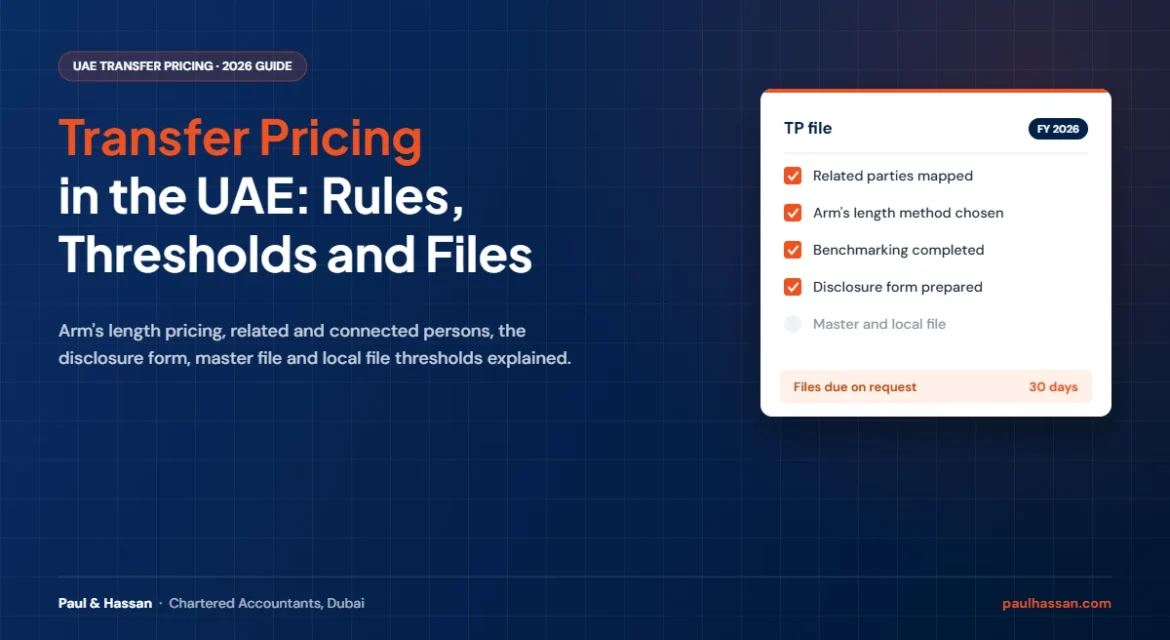
A practical transfer pricing UAE guide for 2026: the arm's length principle, who counts as a related party or connected person, the disclosure form thresholds, master file and local file requirements, methods and the steps to stay compliant.
Transfer pricing used to be a topic for multinational groups only. Under transfer pricing UAE rules, it reaches far more businesses: any company that trades with a sister company, pays a salary to an owner or lends money to a shareholder now has transfer pricing obligations. The rules decide how much profit is taxed in the UAE, and getting them wrong can mean tax adjustments years later.
This guide explains transfer pricing UAE rules in plain language: the arm’s length principle, who counts as a related party or connected person, the disclosure form you file with your return, the thresholds for a master file and local file, the accepted pricing methods and a step by step plan to stay compliant. It reflects the position in November 2026.
Key takeaways on transfer pricing UAE rules
- Transactions with related parties and connected persons must be priced at arm’s length, as if the parties were independent.
- A transfer pricing disclosure form is filed with the corporate tax return when related party transactions exceed AED 40 million, with categories above AED 4 million reported.
- A connected persons schedule applies when payments or benefits to connected persons exceed AED 500,000.
- A master file and local file are required if your revenue is AED 200 million or more, or your multinational group revenue is AED 3.15 billion or more.
- Documentation must be provided within 30 days of an FTA request and kept for 7 years.
Table of Contents
What Is Transfer Pricing?
Transfer pricing is the price charged in transactions between businesses or people that are connected by ownership or control. Typical examples are goods sold by a UAE trading company to its parent, management fees charged by a head office, interest on a shareholder loan, royalties for using a group brand or rent paid to an owner for office space.
Because connected parties do not negotiate like strangers, they can move profit from one company or country to another simply by changing the price. Transfer pricing UAE rules, set out in Articles 34 to 36 and Article 55 of Federal Decree-Law No. 47 of 2022, require these prices to match what independent parties would agree in similar circumstances.
| Item | What applies in 2026 |
|---|---|
| Core rule | Arm’s length principle, Article 34 |
| Related parties | Article 35, generally 50% or more common ownership or control, plus close family links |
| Connected persons | Article 36, owners, directors and officers and their related parties |
| Disclosure form | Filed with the return when related party transactions exceed AED 40 million |
| Master file and local file | Revenue of AED 200 million or more, or group revenue of AED 3.15 billion or more |
| Time to provide documents | Within 30 days of an FTA request |
| Record keeping | At least 7 years after the end of the tax period |
Related Parties and Connected Persons Under Transfer Pricing UAE Rules
Who is a related party?
Two persons are related parties where one controls or owns 50% or more of the other, where both are under 50% or more common ownership or control, or through close family relationships. The main categories are:
- Natural persons related by blood or marriage up to the fourth degree, including through adoption or guardianship
- A natural person and a company that the person, alone or with related parties, owns or controls at 50% or more
- Two or more companies under 50% or more common ownership or control
- A company and its directors or officers
- A head office and its permanent establishment or foreign branch
- Partners in the same unincorporated partnership
Who is a connected person?
Connected persons are a narrower group focused on the people behind a business: owners holding an ownership interest, directors and officers, and related parties of any of them. Payments or benefits to connected persons, such as salaries, bonuses, consultancy fees or rent, are deductible only to the extent they reflect market value and are incurred wholly and exclusively for the business.
Owner salaries are now a tax question
If you run your own company, the salary, bonus and benefits you take are payments to a connected person. Keep evidence that the amount is reasonable for the role, such as market salary data or comparable consultancy rates.
The Arm’s Length Principle and Pricing Methods
Under transfer pricing UAE rules, a related party transaction meets the arm’s length standard when its result falls within the range of results that independent parties would achieve in comparable transactions under comparable circumstances. The UAE follows the OECD Transfer Pricing Guidelines and recognises five main methods.
| Method | How it works | Typical use |
|---|---|---|
| Comparable Uncontrolled Price (CUP) | Compares the price with prices between independent parties for the same or similar item | Commodities, interest on loans, standard goods |
| Resale Price Method | Starts from the resale price and deducts an appropriate gross margin | Distributors that buy from a related party and resell |
| Cost Plus Method | Adds an appropriate mark up to the costs of the supplier | Contract manufacturing, routine services |
| Transactional Net Margin Method (TNMM) | Compares net profit margins with those of comparable independent companies | Most service and distribution arrangements |
| Transactional Profit Split Method | Splits combined profit based on each party’s contribution | Highly integrated operations, unique intangibles |
A different method can be used if none of the five can reasonably be applied, provided it produces an arm’s length result. Whichever method you choose, the reasoning should be documented, along with the comparable data that supports the price.
The Transfer Pricing Disclosure Form
The transfer pricing UAE disclosure form is submitted with the corporate tax return on EmaraTax. Under the FTA’s guidance on the return, it is triggered when the total value of transactions with related parties in the tax period exceeds AED 40 million. Dividends paid to related parties are left out when calculating this figure.
Once the threshold is passed, transactions are reported by category, such as sale of goods, provision of services, intellectual property, financing and interest. Only categories above AED 4 million need to be disclosed. A separate schedule covers connected persons where the aggregate value of payments or benefits exceeds AED 500,000.
| Test | Threshold | What is reported |
|---|---|---|
| Related party transactions in total | More than AED 40 million | Transactions by category, with the counterparty and method |
| Each transaction category | More than AED 4 million | That category in the schedule |
| Payments and benefits to connected persons | More than AED 500,000 in aggregate | Connected persons schedule |
Below the thresholds, transfer pricing UAE rules still apply
Falling below AED 40 million removes the disclosure form, not the arm’s length requirement. The FTA can still review and adjust any related party price.
Master File and Local File Requirements
For transfer pricing UAE documentation, Ministerial Decision No. 97 of 2023 requires a master file and a local file where either of the following applies in the tax period:
- Your own revenue is AED 200 million or more, or
- You are a constituent company of a multinational enterprise group with consolidated group revenue of AED 3.15 billion or more.
The files are not filed with the return. They must be maintained and provided to the FTA within 30 days of a request, or a longer period the FTA allows.
| Document | Content |
|---|---|
| Master file | Group structure, business description, main value drivers, intangibles, intercompany financing, consolidated financial and tax positions, and the group transfer pricing policy |
| Local file | UAE entity management and business, each material controlled transaction, functional analysis, method selected, comparables and benchmarking, and reconciliation to the financial statements |
Preparing a defensible local file takes time, particularly the benchmarking. Our transfer pricing services in Dubai prepare functional analyses, benchmarking studies and both files to OECD standards.
Common Transactions That Need Attention
- Goods bought from or sold to group companies abroad
- Management fees and head office recharges
- Shareholder and intercompany loans, including interest free balances
- Guarantees given by a parent for bank facilities
- Royalties and licence fees for brands, software or know how
- Rent paid to an owner or related company for premises
- Salaries, bonuses and consultancy fees paid to owners or directors
- Cost sharing and staff secondment arrangements
- Free zone and mainland transactions within the same ownership
For free zone companies, these transactions carry an extra risk, because transfer pricing compliance is a condition of the 0% rate. Read our guide to the qualifying free zone person rules for more.
How to Comply With Transfer Pricing UAE Rules: A Step by Step Plan
- 01
Map your related parties and connected persons
List every entity and individual connected to the business by ownership, control or family, including owners, directors and their related parties.
- 02
List all transactions with them
Capture sales, purchases, services, loans, guarantees, rent, salaries and benefits for the tax period, with values.
- 03
Check the thresholds
Compare totals with the AED 40 million, AED 4 million and AED 500,000 disclosure thresholds and the AED 200 million and AED 3.15 billion documentation thresholds.
- 04
Select a pricing method for each transaction
Choose the most appropriate method and record why it fits the facts.
- 05
Benchmark and set prices
Support prices with comparable data, and adjust intercompany agreements and invoices before year end where needed.
- 06
Prepare documentation
Draft intercompany agreements, the disclosure form and, where required, the master file and local file.
- 07
File and retain
Submit the disclosure with the return, keep all records for 7 years and be ready to respond to an FTA request within 30 days.
Risks, Adjustments and Common Mistakes
Where a price breaches transfer pricing UAE rules and is not at arm’s length, the FTA can adjust taxable income to the arm’s length amount. The extra tax then carries late payment penalties, and the original return may need a voluntary disclosure. Adjustments that reduce your own taxable income require prior FTA approval, so they cannot simply be made in the return.
1. Assuming small businesses are exempt
Every taxable person must apply the arm’s length principle. Only the formal documentation depends on size.
2. Leaving shareholder loans undocumented
Interest free or open ended balances need agreements and an arm’s length analysis.
3. Paying owners without evidence
Salaries and fees to connected persons must reflect market value to be deductible.
4. Benchmarking after the year closes
Setting prices first and justifying them later rarely holds up. Review policies before year end.
5. Ignoring free zone conditions
Transfer pricing failures can also cost a free zone company its 0% rate.
Need transfer pricing documentation you can rely on?
Our transfer pricing team in Al Karama, Dubai maps your related party transactions, benchmarks prices, prepares the disclosure form, master file and local file and supports you through FTA queries.
Frequently Asked Questions
Answers to the questions business owners and finance teams ask us most about transfer pricing in the UAE, grouped in two parts.
Part 1 Rules and Scope
Does transfer pricing apply to small businesses in the UAE?
Yes. The arm’s length principle applies to every taxable person with related party or connected person transactions. Only the disclosure form and the master file and local file depend on thresholds.
Who is a related party under UAE corporate tax?
Related parties include persons with 50% or more common ownership or control, family members up to the fourth degree, a company and its directors and officers, and a head office and its branches.
What is a connected person?
A connected person is an owner of the business, a director or officer, or a related party of any of them. Payments to connected persons must reflect market value to be deductible.
Which transfer pricing methods are accepted in the UAE?
The comparable uncontrolled price, resale price, cost plus, transactional net margin and transactional profit split methods, or another method where none of these can reasonably be applied.
Does the UAE follow the OECD guidelines?
Yes. The UAE rules are based on the arm’s length principle and broadly follow the OECD Transfer Pricing Guidelines.
Do transactions between two UAE companies need transfer pricing?
Yes. Domestic related party transactions are covered as well as cross border ones, although some domestic transactions within a tax group are disregarded.
Part 2 Thresholds and Documentation
When do I need to file the transfer pricing disclosure form?
When the total value of related party transactions in the tax period exceeds AED 40 million. Categories above AED 4 million are reported, and connected persons above AED 500,000 go in a separate schedule.
What are the master file and local file thresholds?
You need both files if your revenue in the tax period is AED 200 million or more, or if you belong to a multinational group with consolidated revenue of AED 3.15 billion or more.
Do I submit the master file and local file with my return?
No. You keep them and provide them to the FTA within 30 days of a request.
How long must transfer pricing records be kept?
At least 7 years after the end of the tax period to which they relate.
Can the FTA adjust my prices?
Yes. If a transaction is not at arm’s length, the FTA can adjust taxable income to the arm’s length amount, with late payment penalties on any additional tax.
Can I reduce my taxable income with a transfer pricing adjustment?
Only with prior approval from the FTA. Adjustments that increase taxable income can be made in the return.
Official sources: the Federal Tax Authority transfer pricing guide and corporate tax return guide, decisions published by the UAE Ministry of Finance and the Corporate Tax Law on the UAE Legislation portal.
This article is general information based on UAE corporate tax and transfer pricing rules as of November 2026 and is not tax advice for your specific situation. Thresholds and guidance can change, so confirm current requirements with the Federal Tax Authority or speak to a qualified adviser.