

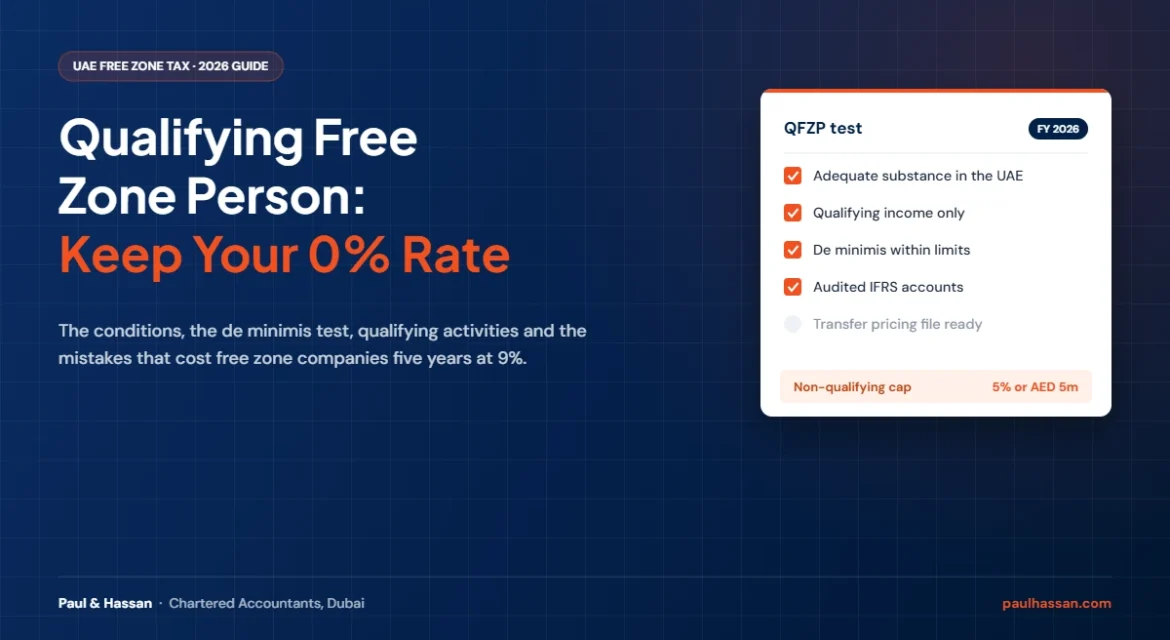
How a qualifying free zone person keeps the 0% UAE corporate tax rate in 2026: the conditions, the de minimis test, qualifying and excluded activities, worked examples and the mistakes that trigger five years at 9%.
Setting up in a UAE free zone no longer means automatic tax freedom. Since corporate tax arrived, a free zone company only pays 0% if it qualifies as a qualifying free zone person, and only on income that counts as qualifying. Get one condition wrong and the business pays 9% for the year of the failure and the following four years.
This guide explains, in plain language, what a qualifying free zone person is, the conditions you must meet every year, how the de minimis test works with real numbers, which activities qualify and which never do, and the practical steps Paul & Hassan Chartered Accountants uses to protect the 0% rate for free zone clients. It reflects the rules in force in November 2026.
Key takeaways on the qualifying free zone person rules
- A qualifying free zone person (QFZP) pays 0% corporate tax on qualifying income and 9% on all other taxable income, with no AED 375,000 nil band on that non qualifying income.
- Status is tested every tax period. You must keep adequate substance, earn qualifying income, pass the de minimis test, follow transfer pricing rules and prepare audited financial statements.
- The de minimis limit is the lower of 5% of total revenue or AED 5 million of non qualifying revenue.
- Failing any condition removes QFZP status for that tax period and the next four, so one bad year can cost five years of 9% tax.
- Small Business Relief is not available to a qualifying free zone person, and you must still register, keep records for 7 years and file a return within 9 months of year end.
Table of Contents
What Is a Qualifying Free Zone Person?
A qualifying free zone person is a juridical person, such as a company or branch, that is incorporated, established or registered in a UAE free zone and meets a set of conditions in the Corporate Tax Law (Federal Decree-Law No. 47 of 2022) and its implementing decisions. Natural persons and sole establishments cannot be a QFZP.
Being located in a free zone only makes you a free zone person. To become a qualifying free zone person, the business has to pass every condition in each tax period. The reward is a split rate: 0% on qualifying income and 9% on taxable income that is not qualifying.
| Item | What applies in 2026 |
|---|---|
| Rate on qualifying income | 0% |
| Rate on non qualifying income | 9% from the first dirham, no AED 375,000 band |
| Who can qualify | Juridical persons licensed in a UAE free zone, including free zone branches |
| How often status is tested | Every tax period |
| Penalty for failing a condition | Standard rates for that period and the following four tax periods |
| Audited financial statements | Required for every QFZP, regardless of size |
| Small Business Relief | Not available to a QFZP |
Registration is still compulsory
A QFZP must register for corporate tax, keep records and file an annual return on EmaraTax like any other taxable person. A 0% result does not remove the filing obligation, and late filing penalties apply even when no tax is payable.
The Conditions a Qualifying Free Zone Person Must Meet
The law sets out the conditions, and Cabinet and Ministerial decisions fill in the detail. In practice, your company must satisfy all of the following for the whole tax period.
- 01
Maintain adequate substance in the UAE
Carry out your core income generating activities in a free zone with enough qualified full time employees, operating expenditure and physical assets for the size of the business. Outsourcing is possible only to a person in the free zone with adequate supervision.
- 02
Derive qualifying income
Earn income from qualifying activities or from transactions with other free zone persons that are the beneficial recipients. Other income must stay within the de minimis limit.
- 03
Do not elect for standard rates
A QFZP can choose to be taxed at the regular rates. Once that election is made, it applies for the period of election and the following four tax periods.
- 04
Pass the de minimis requirement
Non qualifying revenue must not exceed the lower of 5% of total revenue or AED 5 million.
- 05
Follow the arm’s length principle and transfer pricing rules
Price related party and connected person transactions at market value and keep transfer pricing documentation under Articles 34 and 55 of the Corporate Tax Law.
- 06
Prepare audited financial statements
Accounts must be prepared under IFRS (or IFRS for SMEs where allowed) and audited every year, whatever the revenue level.
Substance is where many smaller free zone companies are exposed. A flexi desk licence with no staff in the UAE and decisions taken abroad is unlikely to meet the test for core income generating activities. If you are unsure, our corporate tax advisory team can review your operating model before the year closes.
The De Minimis Test Explained With Numbers
Most free zone businesses earn some income that is not qualifying, for example a small sale to a mainland customer or interest that does not come from a qualifying treasury activity. The de minimis rule allows a small amount of this income without losing status.
The test compares your non qualifying revenue with a cap equal to the lower of 5% of total revenue or AED 5 million. Revenue attributable to a domestic or foreign permanent establishment and certain income from immovable property is left out of the test and taxed separately at 9%.
| Scenario | Total revenue | 5% of revenue | Cap applied | Non qualifying revenue | Result |
|---|---|---|---|---|---|
| Trading company A | AED 40,000,000 | AED 2,000,000 | AED 2,000,000 | AED 1,600,000 | Passes |
| Trading company B | AED 40,000,000 | AED 2,000,000 | AED 2,000,000 | AED 2,400,000 | Fails |
| Group holding company C | AED 150,000,000 | AED 7,500,000 | AED 5,000,000 | AED 4,900,000 | Passes |
| Group holding company D | AED 150,000,000 | AED 7,500,000 | AED 5,000,000 | AED 5,300,000 | Fails |
Company B and company D show why monitoring matters. Neither is far over the limit, yet both lose QFZP status for five tax periods. Tracking non qualifying revenue monthly, not just at year end, gives you time to restructure contracts or move activity before the cap is reached.
Why the cap is a moving target
Because the 5% cap depends on total revenue, a slow sales year lowers your allowance. Budget for the cap using cautious revenue figures, not last year’s results.
Qualifying Activities and Excluded Activities
Income from a qualifying activity can be qualifying even when the customer is on the mainland or overseas, as long as the activity is not an excluded activity. The list is set by Ministerial decision and was updated in 2025. The main qualifying activities are:
- Manufacturing and processing of goods or materials
- Trading of qualifying commodities such as metals and energy products traded on recognised exchanges
- Holding shares and other securities for investment purposes
- Ownership, management and operation of ships
- Reinsurance services and regulated fund management and wealth and investment management
- Headquarter services, treasury and financing services provided to related parties
- Financing and leasing of aircraft, including engines and rotable components
- Distribution of goods or materials in or from a Designated Zone to a customer that resells them, or their parts, or processes them for resale
- Logistics services and activities ancillary to any of the above
Excluded activities can never produce qualifying income, even when the counterparty is another free zone person. They include:
- Transactions with natural persons, except for specific qualifying activities such as ship operations, fund and wealth management and aircraft financing
- Banking activities
- Insurance activities, other than reinsurance and certain captive arrangements
- Finance and leasing activities, other than qualifying treasury, financing and aircraft activities
- Ownership or exploitation of immovable property, other than commercial property in a free zone transacted with free zone persons
- Ownership or exploitation of intellectual property, other than qualifying intellectual property
- Any activity ancillary to an excluded activity
Designated Zones matter for distributors
Distribution income is only qualifying when the goods are distributed in or from a Designated Zone, a specific list of fenced free zone areas such as Jebel Ali Free Zone. A distributor licensed in a free zone that is not a Designated Zone earns non qualifying income on mainland sales.
Doing Business With the Mainland
Selling to mainland customers is the most common way free zone companies drift out of the regime. The general rule is that income from transactions with non free zone persons is only qualifying when it comes from a qualifying activity that is not excluded. Ordinary service income or general trading income from mainland customers is non qualifying and counts toward the de minimis cap.
| Transaction | Usually qualifying? | Why |
|---|---|---|
| Consulting services to another free zone company | Yes | Transaction with a free zone person that is the beneficial recipient |
| Consulting services to a mainland company | No | Not a qualifying activity, counts toward de minimis |
| Goods manufactured in the free zone sold to a mainland retailer | Yes | Manufacturing is a qualifying activity |
| Goods distributed from a Designated Zone to a mainland reseller | Yes | Qualifying distribution activity |
| Goods sold to individual consumers | No | Transactions with natural persons are excluded |
| Rent from an office leased to a mainland company | No | Immovable property income outside the permitted scope |
If your plans include significant mainland sales, compare the options before you commit. A separate mainland entity or branch can keep non qualifying income away from the free zone company. Our guide to free zone business setup in the UAE explains how structure choices affect tax.
What Losing QFZP Status Really Costs
When a condition is failed, the company is treated as a regular taxable person from the start of that tax period and for the next four tax periods. The 0% rate does not return automatically once the problem is fixed.
Take a free zone company with AED 10,000,000 of taxable income a year. As a qualifying free zone person with only qualifying income, its tax is nil. After losing status, it pays 9% on income above AED 375,000, which is AED 866,250 a year, or more than AED 4.3 million across five tax periods, before any penalties for incorrect filing.
| Year | QFZP tax | Tax after losing status |
|---|---|---|
| Year of failure | AED 0 | AED 866,250 |
| Years 2 to 5 | AED 0 | AED 866,250 each year |
| Five year total | AED 0 | AED 4,331,250 |
How to Protect Your 0% Rate: A Practical Checklist
Qualifying free zone person status is earned every year. These are the controls we put in place for free zone clients.
- Map every revenue stream to qualifying, non qualifying or excluded before the year starts
- Track non qualifying revenue monthly against the 5% or AED 5 million cap
- Confirm customers are free zone persons and beneficial recipients, and keep evidence
- Document substance: employees, payroll, premises, board meetings and decision making in the UAE
- Price related party transactions at arm’s length and keep a transfer pricing file
- Book the annual audit early with a UAE registered auditor and prepare IFRS accounts
- Record the qualifying and non qualifying split clearly in the ledger to support the return
- Review the position before signing new contracts with mainland or individual customers
Two of these controls need specialist input. Transfer pricing documentation must stand up to an FTA review, so see our transfer pricing services. The audit must be carried out by an approved auditor, which our audit team in Dubai provides for free zone companies across the UAE.
1. Assuming every free zone company pays 0%
Status depends on meeting all conditions. Many free zone companies pay 9% on part or all of their income.
2. Ignoring small mainland sales
A few mainland service contracts can breach the 5% cap and cost five years of the regime.
3. Relying on a flexi desk with no real activity
Without adequate substance in the UAE, the substance condition fails regardless of income type.
4. Skipping the audit for a small company
Audited financial statements are mandatory for every QFZP. Unaudited accounts break a condition.
5. Mixing excluded income into the same entity
Rent, banking style lending or consumer sales can contaminate the qualifying position. Separate them where possible.
Filing the Corporate Tax Return as a QFZP
The return is due within 9 months after the end of the tax period, on the same day as payment. As a qualifying free zone person you must confirm that each condition was met and report qualifying and non qualifying income separately. The figures must agree with the audited financial statements.
If any income is taxable at 9%, the tax is payable by the same deadline. Our corporate tax return filing service prepares the computation, checks the de minimis position and files on EmaraTax for you.
Want to keep your free zone company at 0%?
Our corporate tax team in Al Karama, Dubai reviews your activities, substance and de minimis position, prepares transfer pricing documentation and audited accounts, and files your return so your qualifying free zone person status is protected.
Frequently Asked Questions
Answers to the questions free zone business owners ask us most often about qualifying free zone person status, grouped in two parts.
Part 1 Status and Conditions
What is a qualifying free zone person in the UAE?
A qualifying free zone person is a company or other juridical person in a UAE free zone that meets all conditions in the Corporate Tax Law, including adequate substance, qualifying income, the de minimis test, transfer pricing compliance and audited financial statements. It pays 0% on qualifying income and 9% on other taxable income.
Does every free zone company pay 0% corporate tax?
No. Only a free zone company that qualifies as a qualifying free zone person pays 0%, and only on qualifying income. A free zone company that fails a condition pays the standard rates of 0% up to AED 375,000 and 9% above it.
Do I need to apply to become a qualifying free zone person?
There is no separate application. You assess the conditions yourself each tax period and declare your status in the corporate tax return, supported by audited accounts and documentation.
Can a freelancer or sole establishment be a QFZP?
No. Only juridical persons, such as companies and branches, can be qualifying free zone persons. Natural persons and sole establishments in free zones are taxed under the normal rules.
What counts as adequate substance?
Your core income generating activities must be carried out in a free zone with enough qualified full time staff, operating expenditure and assets for the business. Outsourcing is allowed only within the free zone and with adequate supervision.
Is an audit mandatory for a qualifying free zone person?
Yes. Every qualifying free zone person must prepare audited financial statements under IFRS for each tax period, regardless of revenue.
Part 2 Income, Tests and Consequences
How is the de minimis limit calculated?
Non qualifying revenue must not exceed the lower of 5% of total revenue or AED 5 million in the tax period. Revenue from permanent establishments and certain immovable property is excluded from the calculation.
Is income from mainland customers qualifying?
Only when it comes from a qualifying activity that is not excluded, such as manufacturing or distribution from a Designated Zone to a reseller. Ordinary services or general trading with mainland customers is non qualifying.
What happens if I exceed the de minimis limit?
The company loses qualifying free zone person status for that tax period and the following four tax periods and pays standard corporate tax rates throughout.
Can a qualifying free zone person claim Small Business Relief?
No. Small Business Relief is not available to qualifying free zone persons, even if revenue is below AED 3 million.
Do transfer pricing rules apply to free zone companies?
Yes. A qualifying free zone person must price related party and connected person transactions at arm’s length and maintain transfer pricing documentation, and must file the disclosure form with its return where required.
Can I choose to pay 9% instead of 0%?
Yes. A qualifying free zone person can elect to be subject to the standard rates, for example to use the AED 375,000 nil band or losses. The election applies for that period and the following four tax periods.
Official sources: the Federal Tax Authority corporate tax guides on free zone persons, decisions published by the UAE Ministry of Finance and the Corporate Tax Law on the UAE Legislation portal.
This article is general information based on UAE corporate tax rules as of November 2026 and is not tax advice for your specific situation. Free zone rules are detailed and change from time to time, so confirm your position with the Federal Tax Authority or speak to a qualified adviser before relying on it.