

A complete corporate tax return filing UAE guide for 2026: who must file, deadlines by year end, what to prepare, the 9 steps on EmaraTax, key elections, transfer pricing and the penalties to avoid.
Every UAE business registered for corporate tax must file a return each year, even when no tax is payable. Getting the corporate tax return filing UAE process right protects you from penalties that start at AED 500 a month and grow quickly. This guide explains who must file, when the deadline falls for your year end, what to prepare and how to submit the return on EmaraTax, step by step.
Paul & Hassan Chartered Accountants has prepared returns since corporate tax took effect for financial years starting on or after 1 June 2023. Everything below reflects the rules in force in November 2026, including Small Business Relief now extended to 2029 and the audited financial statements rules that apply from 2025.
Key takeaways from this corporate tax return filing UAE guide
- Every taxable person registered for corporate tax must file a return, including businesses with no profit or covered by Small Business Relief.
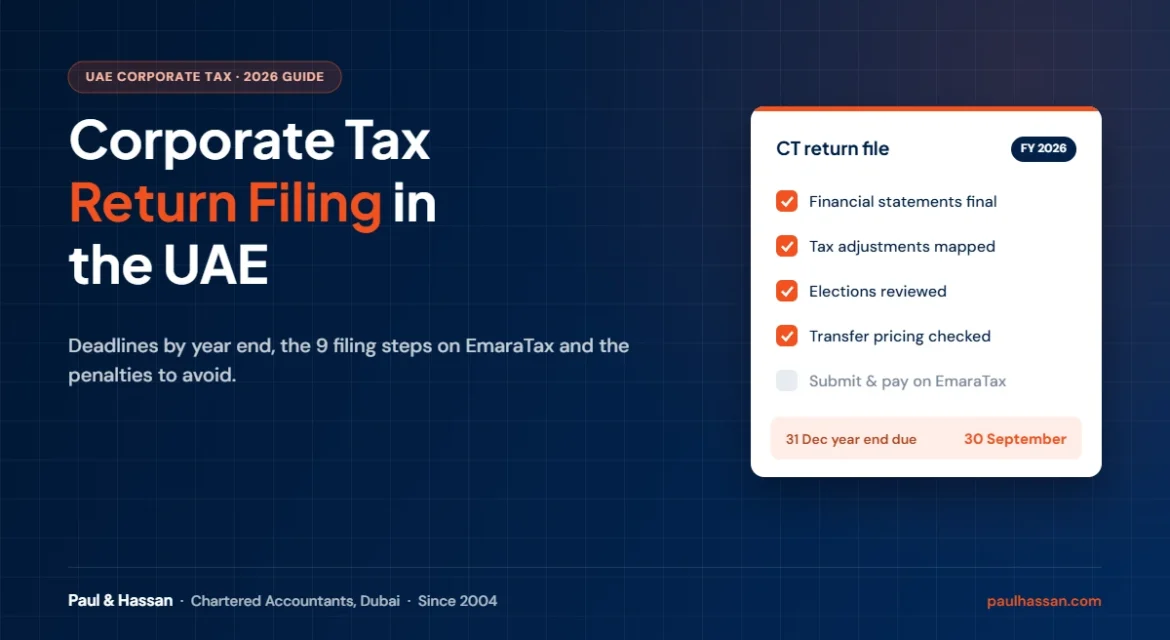
- The return and any tax due are both payable 9 months after the end of your tax period. For a 31 December year end, that is 30 September of the following year.
- Tax is 0% on taxable income up to AED 375,000 and 9% above it. Qualifying Free Zone Persons can pay 0% on qualifying income.
- Late filing costs AED 500 a month for the first 12 months and AED 1,000 a month after that, plus 14% a year on unpaid tax.
- Start with final financial statements, then map tax adjustments, elections and related party data before you open EmaraTax.
Table of Contents
What Is a Corporate Tax Return in the UAE?
A corporate tax return is the annual declaration you submit to the Federal Tax Authority (FTA) under Federal Decree-Law No. 47 of 2022. It starts with the accounting profit in your financial statements, applies the adjustments the law requires and arrives at your taxable income and the tax payable for the period.
The return is filed online on the FTA’s EmaraTax portal. There are no advance or provisional payments in the UAE: the full amount for the year is due once, by the same deadline as the return. That is why a well planned corporate tax return filing UAE routine matters as much as the tax rate itself.
| Item | What applies in 2026 |
|---|---|
| Law | Federal Decree-Law No. 47 of 2022 on the Taxation of Corporations and Businesses |
| Standard rates | 0% up to AED 375,000 of taxable income, 9% above it |
| Free zones | 0% on qualifying income for a Qualifying Free Zone Person, 9% on the rest |
| Where to file | EmaraTax, the FTA online portal |
| Filing deadline | 9 months after the end of the tax period |
| Payment deadline | Same day as the filing deadline |
| Record keeping | At least 7 years after the end of the tax period |
Who Must File a Corporate Tax Return?
Filing is linked to registration, not to profit. If you are a taxable person, you must file, even if the result is a loss or zero tax. That includes:
- Mainland companies such as LLCs, branches and other juridical persons incorporated or effectively managed in the UAE.
- Free zone companies including those that expect to pay 0% as a Qualifying Free Zone Person.
- Individuals in business whose turnover from business activities in the UAE exceeds AED 1 million in a calendar year.
- Non-residents with a permanent establishment or a nexus in the UAE.
- Tax groups which file one return for the group through the parent company.
Businesses that elect Small Business Relief still file. The relief changes how much tax you pay, not whether you report. If you have not registered yet, see our corporate tax registration service first, because a return cannot be filed without a Tax Registration Number.
Corporate Tax Return Filing Deadline UAE: Dates by Year End
The deadline is set by your own financial year, not by the calendar. You must file the return and pay the tax within 9 months after the end of each tax period. Use the table below to find your next corporate tax return filing UAE date.
| Financial year ends | Return and payment due |
|---|---|
| 31 December 2025 | 30 September 2026 (passed) |
| 31 March 2026 | 31 December 2026 |
| 30 June 2026 | 31 March 2027 |
| 30 September 2026 | 30 June 2027 |
| 31 December 2026 | 30 September 2027 |
Check your first tax period
Many companies had an unusual first tax period, sometimes longer than 12 months. Always confirm the exact start date, end date and due date shown in your EmaraTax account before planning the work.
What to Prepare Before You Start
Most delays happen before anyone opens EmaraTax. A complete file makes the return quick to prepare and easy to defend if the FTA asks questions. Gather these items first:
- Final financial statements for the period (audited where required)
- Trial balance and general ledger that agree with the statements
- Fixed asset register with depreciation and any revaluations
- Schedule of related party and connected person transactions
- Details of entertainment, fines, donations and interest expenses
- Dividend, capital gain and foreign branch income records
- Tax losses brought forward from earlier periods
- Copies of any elections made in previous returns
- Free zone substance and qualifying income analysis (free zone companies)
- Payment details for any tax due
Financial statements should follow IFRS. Businesses with revenue below AED 50 million may use IFRS for SMEs, and those with revenue of AED 3 million or less may prepare statements on a cash basis. Our bookkeeping team can bring your records up to this standard if they are behind.
When audited financial statements are required
Under Ministerial Decision No. 84 of 2025, which applies to tax periods starting on or after 1 January 2025, you must keep audited financial statements if your revenue exceeds AED 50 million in the tax period, if you are a Qualifying Free Zone Person, or if you file as a tax group. Plan the audit early, because the return depends on the final numbers. Our audit team works to the corporate tax timeline.
How to File Your Corporate Tax Return on EmaraTax: 9 Steps
Once your file is ready, the corporate tax return filing UAE process on EmaraTax follows a predictable sequence. These are the steps we follow for every client.
- 01
Confirm the tax period and due date
Log in to EmaraTax, open the taxable person profile and check the period dates and due date. Make sure your registration details, such as licence and address, are current.
- 02
Lock the accounting profit
Use only final, signed financial statements. Any change after filing means a voluntary disclosure later.
- 03
Decide on elections
Review Small Business Relief, the realisation basis for unrealised gains and losses, and any group or restructuring relief before entering numbers.
- 04
Map exempt income
Identify qualifying dividends, participation exemption gains and foreign permanent establishment income that should be removed from taxable income.
- 05
Apply the adjustments
Add back non-deductible items such as 50% of client entertainment, fines and penalties, and donations to non-qualifying bodies. Check the interest limitation rule, which caps net interest at 30% of EBITDA above AED 12 million.
- 06
Use available tax losses
Offset brought forward losses up to 75% of taxable income, provided the ownership and business continuity conditions are met.
- 07
Complete the transfer pricing section
Report related party and connected person transactions and attach the disclosure form where your values exceed the thresholds.
- 08
Review and submit
Compare the computed tax with your own calculation, review every section and submit the return. Save the acknowledgement.
- 09
Pay by the same deadline
Pay any tax due through the payment options in EmaraTax by the due date. Payment is not automatic when you submit.
If you prefer not to handle this yourself, our corporate tax return filing service covers every step, and as a registered tax agent we can represent you before the FTA.
Elections and Reliefs That Change Your Tax
Several choices are made inside the return itself. Some apply only if you claim them, and some lock you in for future periods, so review them carefully.
| Election or relief | What it does | Who should consider it |
|---|---|---|
| Small Business Relief | Treats you as having no taxable income for the period | Resident businesses with revenue of AED 3 million or less, until periods ending 31 December 2029 |
| Realisation basis | Taxes gains and losses on assets only when realised | Businesses holding assets at fair value |
| Qualifying group relief | Moves assets within a 75% group without immediate tax | Groups restructuring ownership of assets |
| Business restructuring relief | Defers tax on qualifying mergers and transfers | Companies merging or transferring a business |
| Tax loss transfer | Uses losses across a 75% owned group | Groups with profitable and loss making members |
Small Business Relief deserves a closer look before you elect it. Losses incurred in a year when you elect the relief cannot be carried forward, so a business with a loss and growth plans may be better off not electing. We explain this in detail in our guide to Small Business Relief in the UAE.
Transfer Pricing in the Return
Transactions with related parties and connected persons, such as owners, directors and group companies, must be priced at arm’s length. The return asks for details of these transactions. Where their value exceeds the FTA’s thresholds, you also attach a transfer pricing disclosure form. Businesses with revenue of AED 200 million or more, or that belong to a group with consolidated revenue of AED 3.15 billion or more, must also keep a master file and local file.
Payments to directors and owners are a common blind spot for small companies. They must reflect market value and be documented. Our transfer pricing specialists can review these quickly before you file.
10 Corporate Tax Filing Mistakes to Avoid
1. Filing on draft accounts
Submit only on final statements. Late audit adjustments create corrections and penalties.
2. Missing the deadline because tax is zero
A nil or loss return is still a return. Late filing penalties apply regardless of the tax amount.
3. Confusing the filing and payment steps
Submitting the return does not pay the tax. Both must happen by the due date.
4. Claiming 100% of entertainment
Only 50% of client entertainment is deductible.
5. Deducting fines and penalties
Fines and penalties are never deductible.
6. Ignoring related party payments
Salaries, rent or loans with owners must be at market value and reported.
7. Electing Small Business Relief in a loss year without thinking
The loss is lost forever once you elect.
8. Wrong revenue figure for thresholds
Use revenue under accounting standards, not bank receipts or VAT turnover.
9. Free zone income not analysed
Mixing qualifying and non-qualifying income can cost a free zone company its 0% rate for five tax periods.
10. Poor record keeping
Records must be kept for at least 7 years and produced on request.
Corporate Tax Penalties in 2026
Penalties for corporate tax are set by Cabinet Decision No. 75 of 2023, as amended. Knowing them makes the cost of delay very clear.
| Violation | Penalty |
|---|---|
| Late filing of the return | AED 500 for each month or part month in the first 12 months, then AED 1,000 per month |
| Late payment of tax | 14% a year on the unpaid amount, calculated monthly from the day after the due date |
| Late registration | AED 10,000, waived if the first return is filed within 7 months of the end of the first tax period |
| Errors you correct by voluntary disclosure | 1% for each month on the tax difference, from the original due date |
| Errors found after an FTA audit notice | 15% of the tax difference plus 1% per month |
| Failure to keep records | AED 10,000, and AED 20,000 for a repeat within 24 months |
If a penalty has been applied and you believe it is wrong, you can request reconsideration within 40 business days. Our reconsideration specialists handle these requests for both VAT and corporate tax.
Found an Error After Filing?
If you discover that a return understated your tax, a voluntary disclosure on EmaraTax is mandatory. Disclosing early keeps the penalty to 1% for each month, while an error the FTA finds first costs a fixed 15% of the difference on top. Any additional tax shown on a disclosure is due within 20 business days. From 1 January 2026, disclosures are generally limited to five years after the end of the relevant tax period.
Quick Corporate Tax Return Filing UAE Checklist
- Tax period dates and due date confirmed on EmaraTax
- Financial statements final and audited where required
- Revenue figure confirmed for every threshold test
- Exempt income and non-deductible expenses mapped
- Interest limitation and tax losses calculated
- Small Business Relief and other elections decided
- Related party transactions reviewed at arm’s length
- Transfer pricing disclosure prepared where needed
- Return reviewed, submitted and acknowledgement saved
- Tax paid by the due date and records archived for 7 years
Want your corporate tax return prepared and filed on time?
Our corporate tax team in Al Karama, Dubai prepares the computation, reviews elections and transfer pricing, files the return on EmaraTax and tells you exactly what to pay and when.
Frequently Asked Questions
Answers to the questions UAE business owners ask us most often about corporate tax return filing, in two parts: deadlines and basics, then preparation, reliefs and penalties.
Part 1 Deadlines and Filing Basics
When is the corporate tax return due in the UAE?
The return and any tax payable are due within 9 months after the end of your tax period. For a financial year ending 31 December 2026, the deadline is 30 September 2027.
Do I need to file a corporate tax return if my company made a loss?
Yes. Every taxable person registered for corporate tax must file a return for each tax period, even if the result is a loss or no tax is payable.
Where is the corporate tax return filed?
The return is filed online on EmaraTax, the Federal Tax Authority portal, from the taxable person profile of your registered business.
Are there advance tax payments in the UAE?
No. The UAE has no provisional or advance payments. The full tax for the year is paid once, by the same deadline as the return.
What is the corporate tax rate in the UAE?
Taxable income up to AED 375,000 is taxed at 0% and income above that at 9%. A Qualifying Free Zone Person pays 0% on qualifying income and 9% on other taxable income.
Part 2 Preparation, Reliefs and Penalties
Do I need audited financial statements to file?
Audited statements are required if your revenue exceeds AED 50 million, if you are a Qualifying Free Zone Person or if you file as a tax group. Many free zones and mainland companies also need an annual audit under their own rules.
Do businesses with Small Business Relief still file a return?
Yes. Businesses that elect Small Business Relief must still register, file a simplified return within 9 months and keep their records. The relief is available for tax periods ending on or before 31 December 2029.
What is the penalty for late corporate tax filing?
Late filing costs AED 500 for each month or part month during the first 12 months and AED 1,000 per month after that. Unpaid tax also attracts a late payment penalty of 14% a year.
Can I correct a corporate tax return after filing?
Yes. If the return understated your tax, you must submit a voluntary disclosure on EmaraTax. The penalty is 1% for each month on the tax difference, much lower than the 15% charged when the FTA finds the error first.
How long must I keep corporate tax records?
You must keep financial records and supporting documents for at least 7 years after the end of the tax period they relate to.
This article is general information based on UAE corporate tax rules as of November 2026 and is not tax advice for your specific situation. Rules, thresholds and penalties can change, so confirm current requirements with the Federal Tax Authority or speak to a qualified adviser.