
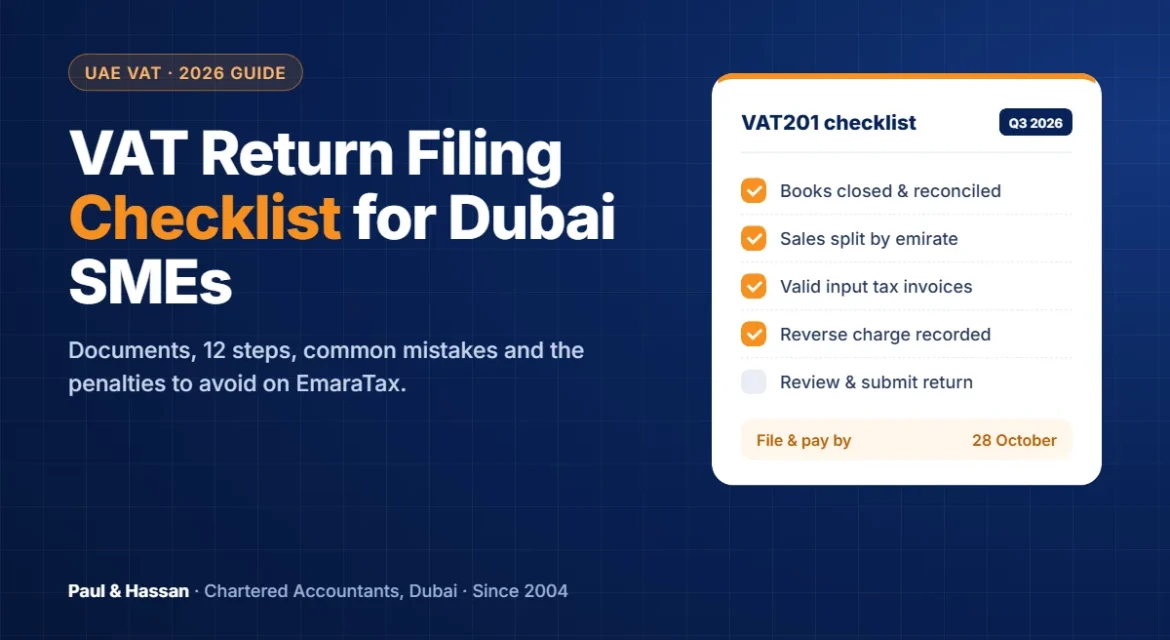
A practical VAT return filing checklist UAE small businesses can follow every quarter: documents to gather, 12 steps to prepare VAT201 in Dubai, common mistakes and the 2026 penalties.
Quarter-end in Dubai often means a desk covered in invoices, receipts and bank statements, and a 28-day countdown to the Federal Tax Authority deadline. This VAT return filing checklist UAE small businesses can follow turns that pile into a clear, repeatable routine, so every return you submit on EmaraTax is complete, accurate and on time.
We have prepared and reviewed VAT returns for Dubai companies since VAT began on 1 January 2018. The VAT return filing checklist UAE below reflects the rules in force in 2026, including the revised penalty schedule that applies from 14 April 2026 and the VAT law amendments that took effect on 1 January 2026.
Key takeaways from this VAT return filing checklist UAE
- Your VAT return (Form VAT201) and any VAT payable are both due within 28 days after your tax period ends.
- Most small businesses file quarterly; check your exact tax period and due dates in EmaraTax.
- Reconcile sales, purchases, imports and bank records before you open the return form.
- Only claim input VAT backed by a valid tax invoice and a business purpose.
- Late filing costs AED 1,000 the first time, and unpaid VAT now attracts a late payment penalty of 14% a year, calculated monthly.
Table of Contents
What Is a VAT Return in the UAE?
A VAT return is the summary you submit to the Federal Tax Authority (FTA) for each tax period. It reports the VAT you charged on sales (output tax), the VAT you paid on business purchases and imports (input tax), and the difference you either pay to the FTA or carry forward as a refund. In the UAE the return is Form VAT201, and it is filed online through the EmaraTax portal.
Every VAT-registered business must file a return for every tax period, even when there were no sales. A nil return is still a return, and missing it triggers the same late filing penalty as any other. That is why any VAT return filing checklist UAE businesses rely on starts with knowing the form and the deadline.
| Item | What applies in 2026 |
|---|---|
| Form | VAT201, filed on EmaraTax |
| Standard rate | 5% (some supplies are zero-rated or exempt) |
| Usual tax period for SMEs | Quarterly (the FTA can assign monthly periods) |
| Filing deadline | 28 days after the end of the tax period |
| Payment deadline | Same day as the filing deadline |
| Example | Quarter ending 30 September: file and pay by 28 October |
Who Should Use This VAT Return Filing Checklist UAE Guide?
This guide is written for owner-managed companies, startups and SMEs in Dubai and the other emirates. If your taxable supplies and imports exceeded AED 375,000 over the last 12 months, VAT registration is mandatory. Businesses above AED 187,500 can register voluntarily. Once you hold a Tax Registration Number (TRN), the filing duty starts with your first tax period.
Use the VAT return filing checklist UAE steps below if you file the return yourself, if a part-time bookkeeper prepares it, or if you simply want to review the figures before your accountant submits them. If you are not registered yet, start with our VAT registration service in Dubai.
VAT Return Filing Documents UAE Businesses Must Gather First
Most errors begin with missing paperwork. Before you prepare anything, collect the VAT return filing documents UAE rules expect you to keep for the whole period. Having them in one folder, physical or digital, also makes an FTA audit far less stressful.
| Document | Why you need it |
|---|---|
| Sales tax invoices and credit notes | Support your output VAT and any reductions to it |
| Sales register by emirate | Box 1 of VAT201 splits standard-rated sales by emirate |
| Purchase tax invoices from suppliers | Required to claim input VAT |
| Expense receipts and petty cash records | Shows which small expenses qualify for recovery |
| Import customs declarations | Support VAT on imports reported in the return |
| Contracts and invoices for services from abroad | Needed for reverse charge reporting |
| Export evidence (bills of lading, airway bills) | Proves zero-rating on exported goods |
| Bank statements for the period | Confirms sales and payments were recorded |
| Previous VAT return and FTA correspondence | Carries forward balances and open issues |
| Fixed asset purchase invoices | Large capital purchases often carry significant input VAT |
Keep these VAT return filing documents UAE law requires for at least five years after the end of the tax period they relate to. Records linked to real estate must be kept for 15 years. From 1 January 2026 you no longer issue self-invoices for reverse charge purchases, so the supplier invoice, contract and payment proof now carry the full weight of your evidence.
How to Prepare VAT Return in Dubai: The 12-Step VAT Return Filing Checklist UAE
Here is exactly how to prepare VAT return in Dubai, step by step, using a VAT return filing checklist UAE accountants apply every quarter. Work through the list in order. Each step builds on the one before, and ticking them off creates a review trail you can show an auditor.
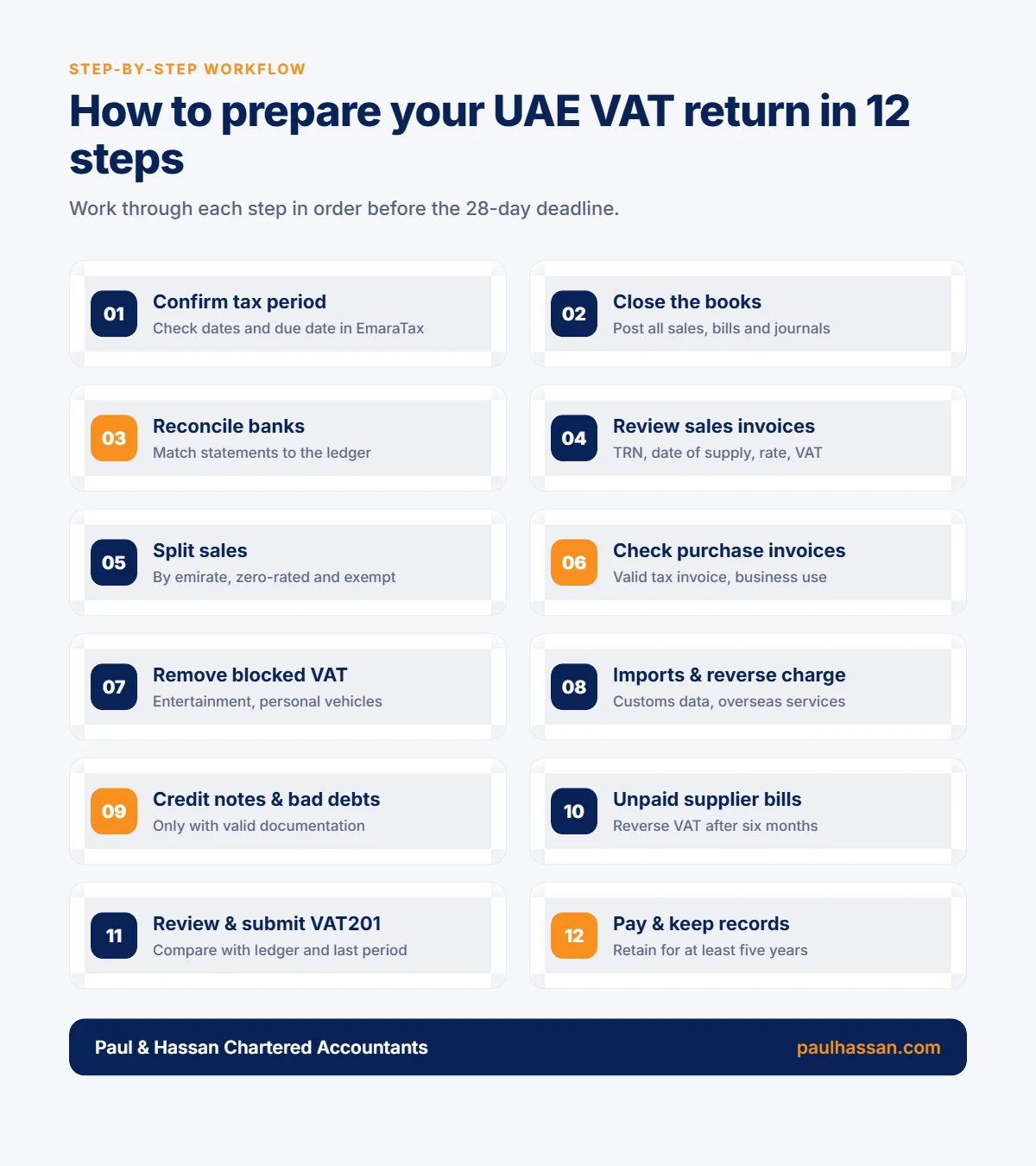
- 01
Confirm your tax period and due date
Log in to EmaraTax and check the start date, end date and due date of the period you are filing. New registrants often have a first tax period of unusual length, so never assume a calendar quarter.
- 02
Close the books for the period
Post every sales invoice, purchase bill, expense claim and journal for the period before you extract any figures. A return built on open books will need correcting later.
- 03
Reconcile your bank accounts
Match each bank and card statement to your ledger. Unrecorded receipts are often unrecorded sales, and unrecorded payments may hide input VAT you are entitled to recover.
- 04
Review every sales invoice
Check that each tax invoice shows your TRN, the customer details where required, the date of supply, the VAT rate and the VAT amount. Tax invoices must normally be issued within 14 days of the date of supply.
- 05
Split sales by emirate and VAT treatment
Separate standard-rated sales by the emirate of your establishment, then list zero-rated exports and exempt supplies. Box 1 of VAT201 needs the emirate split, and Boxes 4 and 5 hold zero-rated and exempt supplies.
- 06
Check purchase invoices before claiming input VAT
Claim input VAT only where you hold a valid tax invoice in your company name, the expense relates to taxable business activity, and the supplier is genuinely VAT registered. Verify unfamiliar supplier TRNs on the FTA website.
- 07
Remove blocked input VAT
VAT on business entertainment of non-employees, motor vehicles available for personal use, and certain staff benefits cannot be recovered. Exclude it before it reaches your return.
- 08
Account for imports and reverse charge
Record VAT on imported goods using your customs declarations, and apply the reverse charge to services bought from overseas suppliers. Both are reported as output and input tax in the same return.
- 09
Apply credit notes and bad debt relief
Reduce output VAT only where you issued a valid tax credit note. Bad debt relief has its own conditions, including writing the debt off and notifying the customer.
- 10
Review unpaid supplier bills
If you have not paid a supplier within six months after the agreed payment date, the input VAT you claimed on that invoice must be reversed. Clear or adjust these items now.
- 11
Prepare, review and submit VAT201
Enter the figures into EmaraTax, compare them with the previous quarter and with your ledger, then submit before the deadline. A second person reviewing large swings is one of the cheapest controls you can add.
- 12
Pay and file your records
Pay any VAT due by the same deadline using the payment reference shown in EmaraTax. Save the submitted return, the working file and the payment receipt with this period’s documents.
Practical tip
Start the VAT return filing checklist UAE routine on day one after the quarter ends, not on day 25. Most of the 28 days are needed for chasing missing invoices, not for filling in the form.
Understanding the VAT201 Form Box by Box
Knowing what each section of the form expects makes it easier to check your figures before you submit. The table below is a simplified guide to the main sections of VAT201, and it supports step 11 of the VAT return filing checklist UAE above.
| Section | What goes in it |
|---|---|
| Box 1 (1a to 1g) | Standard-rated supplies and output VAT, split by emirate |
| Box 2 | Tax refunds provided to tourists (only for retailers in the tourist refund scheme) |
| Box 3 | Supplies subject to the reverse charge |
| Boxes 4 and 5 | Zero-rated supplies and exempt supplies |
| Boxes 6 and 7 | Goods imported into the UAE and adjustments to imports |
| Box 8 | Total value of supplies and output VAT |
| Boxes 9 and 10 | Standard-rated expenses and reverse charge purchases, with recoverable input VAT |
| Boxes 11 to 14 | Total input VAT, total VAT due, recoverable VAT and the net amount payable or refundable |
If the return shows a refundable amount, you can carry it forward or request a refund. Under the January 2026 amendments, excess refundable tax must be reclaimed within five years, after which the right to reclaim it expires. Our VAT refund service can prepare and track the claim for you.
10 VAT Filing Mistakes UAE Small Businesses Make (and How to Avoid Them)
After years of reviewing returns, we see the same VAT filing mistakes UAE small businesses repeat every quarter. Almost all of them are avoidable with a short review before submission.
1. Missing the 28-day deadline
Set calendar reminders for each period end and for day 20. A late return costs AED 1,000 even when no VAT is due.
2. Not filing a nil return
If you made no sales, you must still file. Silence counts as late filing.
3. Claiming VAT without a valid tax invoice
A receipt or proforma is not enough. Ask suppliers for a proper tax invoice in your company name.
4. Claiming blocked expenses
Client entertainment, personal-use vehicles and some staff benefits are blocked. Tag them separately in your accounts.
5. Wrong emirate allocation
Sales must be reported against the emirate of the establishment that made them, not where the customer is.
6. Mixing up zero-rated and exempt sales
Zero-rated sales keep input VAT recovery. Exempt sales can restrict it. Confirm the treatment before you invoice.
7. Forgetting reverse charge on imports
Software subscriptions, marketing tools and other services from abroad usually fall under the reverse charge.
8. Ignoring unpaid supplier bills
Input VAT on bills unpaid six months after the agreed date must be reversed.
9. Timing errors
VAT follows the date of supply rules, not the date cash was received. Invoices raised late still belong to the right period.
10. Not reconciling to the ledger
If VAT201 does not agree with your VAT control account, something is wrong. Find it before the FTA does.
Avoiding these VAT filing mistakes UAE small businesses commonly make is the fastest way to cut penalty risk. If several items on this list sound familiar, a one-off VAT health check can clean up past periods before they become a problem.
VAT Penalties in the UAE: What Applies in 2026
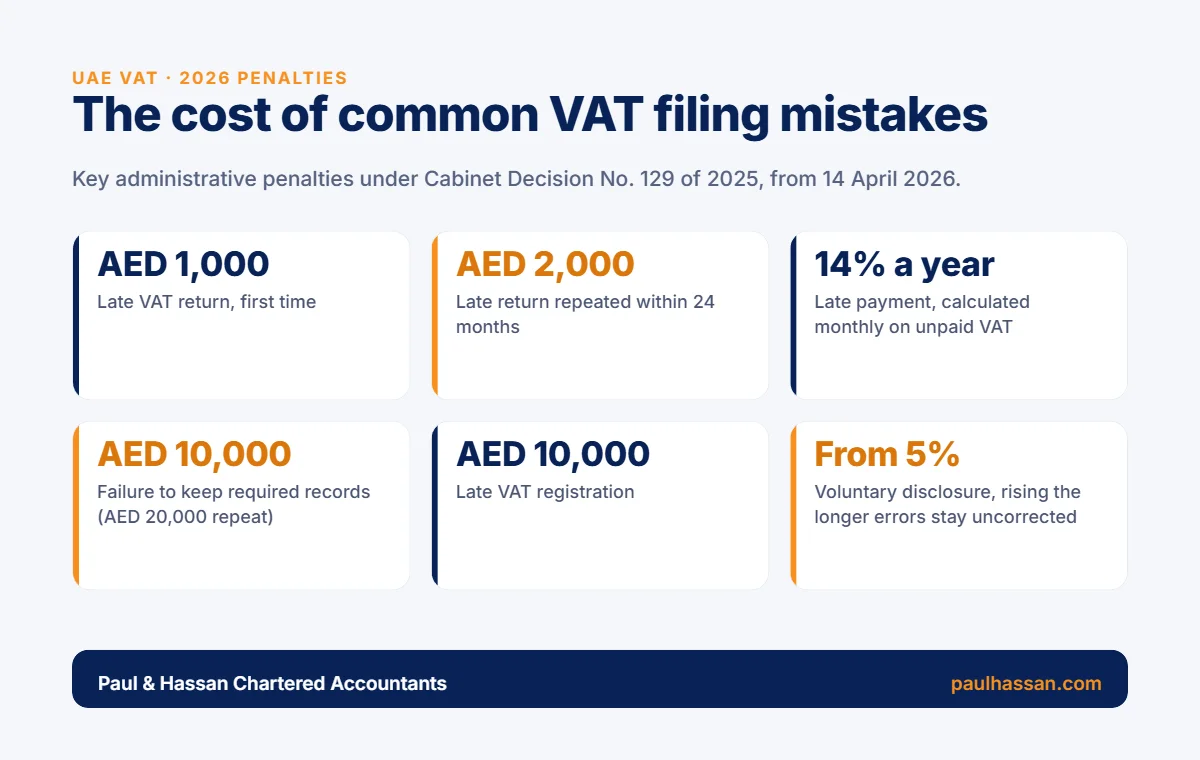
A revised schedule of administrative penalties, set out in Cabinet Decision No. 129 of 2025, applies from 14 April 2026. The table summarises the penalties most relevant to VAT returns. Penalties are the real cost of the VAT filing mistakes UAE small businesses make, so it pays to know them. Always confirm the current figures on the Federal Tax Authority website before relying on them.
| Violation | Penalty |
|---|---|
| Late VAT return (first time) | AED 1,000 |
| Late VAT return (repeat within 24 months) | AED 2,000 |
| Late payment of VAT | 14% a year on the unpaid amount, calculated monthly |
| Failure to keep required records | AED 10,000 (AED 20,000 for a repeat) |
| Late VAT registration | AED 10,000 |
| Errors corrected by voluntary disclosure | A percentage of the tax difference that rises the longer the error stays uncorrected, starting at 5% in the first year |
Found an Error After Filing? Correct It the Right Way
Mistakes happen. What matters is how quickly you correct them. If an error in a submitted return changes the tax payable by AED 10,000 or less, you can usually correct it in the return for the period in which you discovered it. If the difference is more than AED 10,000, you must submit a voluntary disclosure on EmaraTax. Add an error review to your VAT return filing checklist UAE routine so problems surface early.
Correcting early is always cheaper. The voluntary disclosure penalty grows with each year that passes, and errors found by the FTA during an audit are treated more harshly than errors you disclose yourself. If the FTA has already issued a penalty you believe is wrong, our team handles VAT reconsideration requests.
What Changed for VAT Returns in 2026
Several updates affect how you prepare returns this year, so update your VAT return filing checklist UAE process for each of them:
- No more reverse charge self-invoices. From 1 January 2026, keep the supplier invoice, contract and payment evidence instead.
- Five-year limit on refund claims. Excess refundable VAT must be reclaimed within five years.
- Supplier due diligence. The FTA can deny input VAT on purchases linked to a tax evasion arrangement, so verify suppliers before you claim.
- New penalty schedule. From 14 April 2026, late payment penalties are calculated at 14% a year, monthly.
- E-invoicing is coming. Businesses with revenue of AED 50 million or more must comply from 1 January 2027, and other businesses from 1 July 2027.
E-invoicing will change where your VAT data comes from, so it is worth aligning your invoicing system now. See our UAE e-invoicing readiness service for a practical roadmap.
Quick Quarterly VAT Return Filing Checklist UAE (Save This)
Use this condensed version of the VAT return filing checklist UAE businesses can run through every quarter. Print it, or copy it into your task manager.
- Tax period dates and due date confirmed in EmaraTax
- All sales, purchases and expenses posted for the period
- Bank and card statements reconciled
- Sales invoices checked for TRN, date, rate and VAT amount
- Sales split by emirate, zero-rated and exempt
- Input VAT supported by valid tax invoices
- Blocked expenses removed
- Imports and reverse charge services recorded
- Credit notes and bad debts reviewed
- Bills unpaid for more than six months adjusted
- VAT201 reviewed against the ledger and last quarter
- Return submitted, VAT paid, records saved
Let Paul & Hassan Handle Your VAT Return
Paul & Hassan Chartered Accountants has supported businesses in Dubai since 2004. Our VAT team prepares and reviews returns, reconciles your records, and files on EmaraTax as your registered tax agent when required. We combine VAT work with monthly bookkeeping so your figures are ready long before the deadline.
Want your next VAT return filed correctly and on time?
Talk to our VAT specialists in Al Karama, Dubai. We will review your records, run the VAT return filing checklist UAE for you every quarter and give you a clear quote.
Frequently Asked Questions
Answers to the questions Dubai business owners ask us most often about this VAT return filing checklist UAE guide, in two parts: filing basics and deadlines, then documents, mistakes and penalties.
Part 1 VAT Return Filing Basics and Deadlines
When is the VAT return due in the UAE?
The VAT return and any VAT payable are due within 28 days after the end of each tax period. For a quarter ending 30 June, for example, the deadline is 28 July.
How often do small businesses file VAT returns in Dubai?
Most small and medium-sized businesses file quarterly. The FTA can assign monthly tax periods, usually to larger businesses, so always check the tax period and due dates shown in your EmaraTax account.
Where do I file my VAT return?
VAT returns are filed online on the FTA’s EmaraTax portal using Form VAT201. You log in with your account, select the open tax period, complete the form and submit it. Submitting VAT201 is the final step of any VAT return filing checklist UAE businesses follow.
Do I need to file a VAT return if I had no sales?
Yes. Every VAT-registered business must file a return for every tax period. If you had no activity, submit a nil return by the deadline to avoid a late filing penalty.
When do I have to pay the VAT due?
Payment is due by the same deadline as the return: 28 days after the end of the tax period. Pay using one of the payment methods offered in EmaraTax and keep the payment confirmation with your records. Paying late is one of the costly VAT filing mistakes UAE small businesses can easily avoid.
What should a VAT return filing checklist UAE include?
A complete VAT return filing checklist UAE businesses can rely on covers confirming the tax period, closing the books, reconciling bank accounts, checking sales and purchase invoices, removing blocked input VAT, recording imports and reverse charge, reviewing credit notes and unpaid bills, and reviewing VAT201 before you submit and pay.
How long does it take to prepare a VAT return?
For a small business with organised records it can take a few hours. Most of the time goes into collecting missing invoices and reconciling accounts, which is why learning how to prepare VAT return in Dubai with a checklist and monthly bookkeeping saves so much effort.
Can an accountant or tax agent file my VAT return?
Yes. A registered tax agent or your accountant can prepare and submit the return on your behalf. Your business remains responsible for the accuracy of the figures, so review the return before it is filed.
What is the difference between zero-rated and exempt supplies on the return?
Both are reported in VAT201 without output VAT, but they work differently. Zero-rated supplies, such as most exports, still allow you to recover related input VAT. Exempt supplies, such as certain financial services and bare land, can restrict input VAT recovery.
What happens if my VAT return shows a refund?
If your input VAT is higher than your output VAT, the excess can be carried forward to future periods or claimed as a refund on EmaraTax. Under the 2026 amendments, excess refundable tax must be reclaimed within five years.
Part 2 Documents, Mistakes and Penalties
What documents do I need to file a VAT return in Dubai?
You need sales and purchase tax invoices, credit notes, import customs declarations, contracts for services from abroad, export evidence, bank statements and your previous return. These are the core VAT return filing documents UAE rules require, and you should keep them for at least five years.
How long must I keep VAT records in the UAE?
Keep VAT records for at least five years after the end of the tax period they relate to. Records linked to real estate must be kept for 15 years. Failing to keep required records can lead to a penalty of AED 10,000 for a first violation.
Can I claim input VAT without a tax invoice?
Generally, no. To recover input VAT you need a valid tax invoice issued to your business, or a customs declaration for imported goods. Simplified receipts or proforma invoices are usually not enough, so request a proper tax invoice from every supplier.
Which expenses are blocked from input VAT recovery?
VAT on business entertainment of non-employees, motor vehicles available for personal use, and certain employee benefits generally cannot be recovered. Tag these expenses separately in your accounts so they never reach the input VAT figure in your return.
What are the most common VAT filing mistakes UAE small businesses make?
The most common VAT filing mistakes UAE small businesses make are missing the deadline, skipping nil returns, claiming VAT without valid tax invoices, claiming blocked expenses, wrong emirate allocation, forgetting the reverse charge on imported services and not reconciling the return to the ledger.
What is the penalty for late VAT filing in the UAE?
A late VAT return costs AED 1,000 the first time and AED 2,000 for a repeat within 24 months. These penalties apply even when no VAT is payable for the period.
What is the late payment penalty for VAT in 2026?
From 14 April 2026, unpaid VAT attracts a late payment penalty of 14% a year on the outstanding amount, calculated monthly from the day after the due date, under Cabinet Decision No. 129 of 2025.
Can I correct a mistake in a VAT return already filed?
Yes. If the error changes the tax by AED 10,000 or less, you can usually adjust it in the return for the period in which you found it. Larger errors require a voluntary disclosure on EmaraTax.
What is a VAT voluntary disclosure?
A voluntary disclosure is the form you submit on EmaraTax to correct an error in a return you have already filed. Disclosing an error yourself, and doing it early, attracts a lower penalty than an error the FTA discovers during an audit.
Do I still need self-invoices for reverse charge purchases in 2026?
No. From 1 January 2026, businesses no longer have to issue self-invoices for reverse charge transactions. You must still keep the supplier invoice, contract and payment evidence to support the VAT you report.
This article is general information based on UAE VAT rules as of October 2026 and is not tax advice for your specific situation. Rules and penalty amounts can change, so confirm current requirements with the Federal Tax Authority or speak to a qualified adviser.