

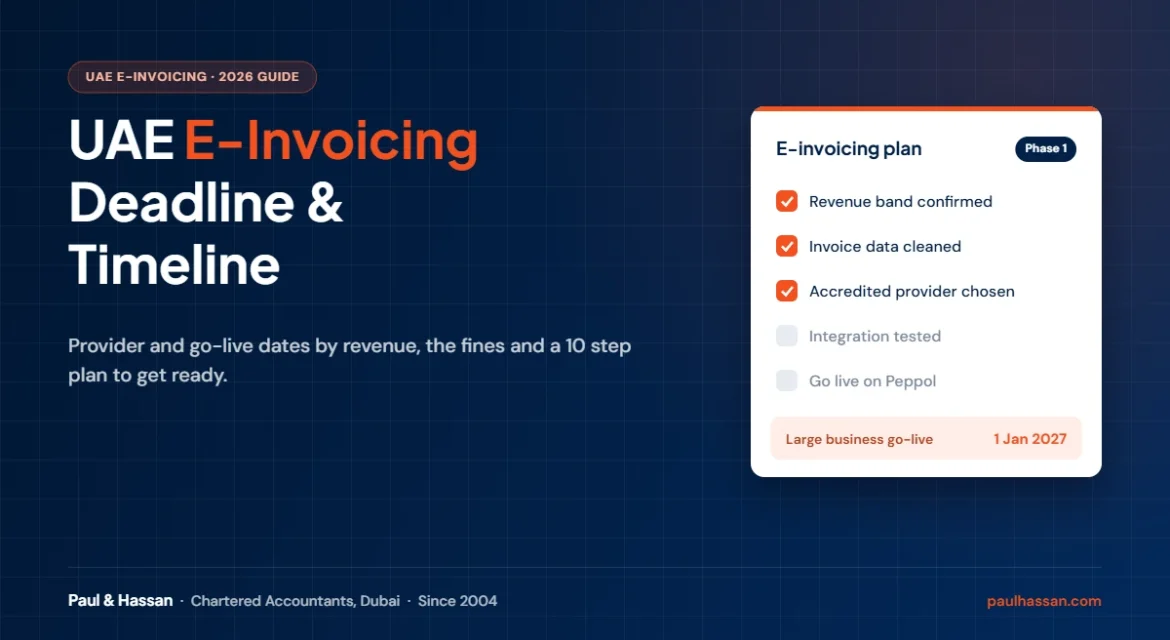
Every UAE e-invoicing deadline in one place: provider appointment and go-live dates by revenue, who is in scope, how the Peppol system works, the fines and a 10 step readiness plan.
E-invoicing is the biggest change to how UAE businesses bill each other since VAT arrived in 2018. Within months, a PDF sent by email will no longer count as a valid invoice for most business to business sales. This guide sets out every UAE e-invoicing deadline, who is in scope, how the new system works, the fines for missing it and a practical plan to get ready.
The timeline below reflects the Ministry of Finance decisions in force in November 2026, including Ministerial Decision No. 168 of 2026 on accredited service providers, which took effect on 1 October 2026, and the Federal Tax Authority confirmation of the go-live dates on 29 September 2026.
Key takeaways on the UAE e-invoicing deadline
- Businesses with revenue of AED 50 million or more had to appoint an accredited service provider by 30 October 2026 and must go live on 1 January 2027.
- Businesses with revenue below AED 50 million must appoint a provider by 31 March 2027 and go live on 1 July 2027.
- E-invoices are structured data exchanged through accredited providers on the Peppol network. PDFs, scans and Word files do not qualify.
- Business to business and business to government sales are in scope. Sales to consumers are excluded for now.
- Missing the deadline can cost AED 5,000 a month, plus AED 100 for each invoice not issued on time.
Table of Contents
What Is E-Invoicing in the UAE?
An e-invoice is invoice data in a structured, machine readable format that moves directly from the supplier’s system to the buyer’s system and is reported to the FTA at the same time. Nobody types it in again and nobody needs to open a PDF. The UAE system is built on Peppol, an international network already used across Europe, Australia and Singapore, with a UAE specific data standard.
Five parties take part in every transaction: the supplier, the supplier’s accredited service provider, the buyer’s accredited service provider, the buyer and the FTA. Your provider validates the invoice, sends it through the network and passes the tax data to the authority. This is why appointing a provider is the first milestone of every UAE e-invoicing deadline.
| Legislation | What it covers |
|---|---|
| Ministerial Decision No. 243 of 2025 | The legal and operational framework of the Electronic Invoicing System |
| Ministerial Decision No. 244 of 2025 | The phased implementation timeline |
| Cabinet Resolution No. 106 of 2025 | Administrative fines for non-compliance |
| Ministerial Decision No. 168 of 2026 | Accreditation of service providers, effective 1 October 2026 |
| Ministerial Decision No. 66 of 2026 | Moved the large business provider deadline from 31 July to 30 October 2026 |
UAE E-Invoicing Deadline: The Full Timeline
Implementation is phased by revenue. Revenue here means your gross income in the most recent accounting period, not profit and not VAT turnover. Find your group in the table below.
| Who | Appoint an accredited provider by | Go live with e-invoicing |
|---|---|---|
| Voluntary adopters and the pilot group | Any time | From 1 July 2026 |
| Businesses with revenue of AED 50 million or more | 30 October 2026 | 1 January 2027 |
| Businesses with revenue below AED 50 million | 31 March 2027 | 1 July 2027 |
| Government entities in scope | 31 March 2027 | 1 October 2027 |
If you are a large business and missed 30 October
Appoint a provider now and document the date. The monthly fine for failing to appoint a provider or implement the system starts from the deadline, so every week counts. Go-live on 1 January 2027 is unchanged.
Who Is in Scope?
The rules apply to all persons conducting business in the UAE unless they are specifically excluded. That reaches further than many owners expect.
- VAT registered and unregistered businesses are both in scope. Registration for VAT is not the test.
- Business to business sales between UAE businesses are the core of the system.
- Business to government sales are in scope, with government entities on their own timeline.
- Buyers as well as sellers because you need a provider to receive e-invoices from your suppliers, not only to send them.
- Credit notes follow the same rules as invoices and must be issued electronically too.
The current exclusions are narrow. They cover sovereign government activities that do not compete with the private sector, certain international passenger and goods transport by airlines, and certain exempt or zero-rated financial services. Sales to individual consumers for personal use are outside the system until further notice.
How the E-Invoicing System Works in Practice
- 01
You raise the invoice in your system
Your accounting or ERP system creates the invoice with all mandatory fields, such as TRNs, item details, VAT amounts and totals.
- 02
Your provider validates it
Your accredited service provider checks the data against the UAE standard and rejects invoices with errors before they go out.
- 03
It travels over Peppol
The provider sends the invoice through the Peppol network to your customer’s provider.
- 04
Your customer receives structured data
The buyer’s provider delivers the invoice straight into the customer’s system, ready to process.
- 05
The FTA receives the tax data
The tax data is reported to the authority as part of the same flow.
Timing matters. For VAT registered businesses, e-invoices follow the existing VAT time of supply rules. Businesses that are not registered for VAT must transmit the e-invoice within 14 days of the transaction. If your system fails, you must tell the FTA within two business days.
E-Invoicing Fines and Penalties
Cabinet Resolution No. 106 of 2025 sets the administrative fines. They apply once your phase becomes mandatory; voluntary users are not fined until then.
| Violation | Fine |
|---|---|
| Failing to implement the system or appoint an accredited provider on time | AED 5,000 for each month |
| Each e-invoice not issued or transmitted on time | AED 100 per invoice, capped at AED 5,000 a month |
| Each e-credit note not issued or transmitted on time | AED 100 per credit note, capped at AED 5,000 a month |
| Not telling the FTA about a system failure on time | AED 1,000 for each day of delay |
| Not telling your provider about changes to your registered data | AED 1,000 for each day of delay |
Separately, the VAT penalty rules include a fine of AED 2,500 for each detected case where a required tax invoice, credit note or e-invoice is not issued. Fines can add up quickly for a business that issues hundreds of invoices a month.
How to Prepare for Your UAE E-Invoicing Deadline: 10 Steps
- 01
Confirm your revenue band
Use gross revenue from your latest accounting period to see whether your provider deadline is 30 October 2026 or 31 March 2027.
- 02
Map every invoice flow
List sales invoices, purchase invoices, credit notes, self-billing, intercompany charges and any invoices raised by hand.
- 03
Clean your master data
Check customer and supplier TRNs, legal names, addresses, item codes and units of measure. Most rejections come from bad data.
- 04
Check your accounting system
Ask your software vendor whether it supports the UAE e-invoicing format and how it connects to providers.
- 05
Choose an accredited provider
Select a provider on the Ministry of Finance accredited list. Since 1 October 2026 only fully accredited providers can operate.
- 06
Plan integration and testing
Connect your system to the provider, then test sales, purchases and credit notes with real scenarios.
- 07
Update processes and controls
Decide who fixes rejected invoices, how quickly, and how exceptions are approved.
- 08
Talk to customers and suppliers
Confirm their providers and their readiness so invoices flow from day one.
- 09
Train your team
Finance, sales and procurement staff should all know the new steps and timelines.
- 10
Go live and monitor
Track rejected invoices, outages and data changes in the first months and fix root causes fast.
Our UAE e-invoicing team runs readiness reviews, helps choose a provider and tests your invoice data before go-live. If your books need tidying first, our accounting services team can help.
7 E-Invoicing Mistakes to Avoid
1. Thinking a PDF by email is enough
It is not. Only structured data exchanged through an accredited provider counts.
2. Assuming only VAT registered businesses are affected
Registration for VAT is not the test. Most businesses are in scope.
3. Forgetting the buying side
You need a provider to receive e-invoices, not only to send them.
4. Ignoring credit notes
Credit notes must be electronic too, with their own fines.
5. Leaving data clean-up to the last week
Wrong TRNs and addresses cause rejections and late invoices.
6. Choosing a provider without checking accreditation
Preliminary approval ended on 1 October 2026. Use only fully accredited providers.
7. No plan for system failures
You must report outages within two business days.
The Upside: What E-Invoicing Gives Your Business
- Faster payment because invoices arrive in the customer’s system immediately and errors are caught up front.
- Less manual work as purchase invoices no longer need to be keyed in.
- Cleaner VAT returns because sales and purchase data already match what the FTA sees.
- Fewer disputes with standard data and a clear delivery trail.
- Better cash flow visibility with real time status on every invoice.
UAE E-Invoicing Readiness Checklist
- Revenue band and deadlines confirmed
- Invoice, credit note and purchase flows mapped
- Customer and supplier master data cleaned
- Accounting system capability confirmed
- Accredited service provider appointed
- Integration built and tested end to end
- Rejection and exception process agreed
- Customers and suppliers informed
- Staff trained
- Outage reporting process in place
Need help meeting your UAE e-invoicing deadline?
Our team in Al Karama, Dubai reviews your invoice data, helps you select an accredited provider, tests your setup and supports you through go-live.
Frequently Asked Questions
Answers to the questions we hear most about UAE e-invoicing, in two parts: deadlines and scope, then setup, providers and fines.
Part 1 Deadlines and Scope
What is the UAE e-invoicing deadline for large businesses?
Businesses with revenue of AED 50 million or more had to appoint an accredited service provider by 30 October 2026 and must start issuing e-invoices on 1 January 2027.
When do smaller businesses have to start e-invoicing?
Businesses with revenue below AED 50 million must appoint an accredited service provider by 31 March 2027 and go live on 1 July 2027.
Does e-invoicing apply to businesses not registered for VAT?
Yes. The system applies to persons conducting business in the UAE whether or not they are registered for VAT. Unregistered businesses must transmit e-invoices within 14 days of the transaction.
Are sales to consumers included?
Not for now. Business to consumer transactions are excluded until further notice. Business to business and business to government transactions are in scope.
Is a PDF invoice sent by email an e-invoice?
No. An e-invoice is structured data exchanged electronically through accredited service providers. PDFs, Word files, photos and scans do not qualify.
Part 2 Setup, Providers and Fines
What is an accredited service provider?
It is a company accredited by the Ministry of Finance to validate, send and receive e-invoices on the Peppol network and report tax data to the FTA. Both the supplier and the buyer need one.
How do I know if a provider is accredited?
Check the Ministry of Finance list of accredited providers. Since 1 October 2026 the preliminary approval stage has been removed, so only fully accredited providers can operate.
What is the fine for missing the e-invoicing deadline?
Failing to implement the system or appoint an accredited provider on time costs AED 5,000 for each month. Each e-invoice or e-credit note not issued on time costs AED 100, capped at AED 5,000 a month.
Can my business start e-invoicing early?
Yes. Voluntary adoption has been possible since 1 July 2026, and fines do not apply to voluntary users until their mandatory phase begins.
How long does it take to get ready for e-invoicing?
Most mid-sized businesses need three to six months to clean data, choose a provider, integrate systems and test. Starting early avoids rushed testing close to the deadline.
This article is general information based on UAE e-invoicing legislation and guidance as of November 2026 and is not advice for your specific situation. Timelines and requirements can change, so confirm current rules with the Ministry of Finance and the Federal Tax Authority or speak to a qualified adviser.