
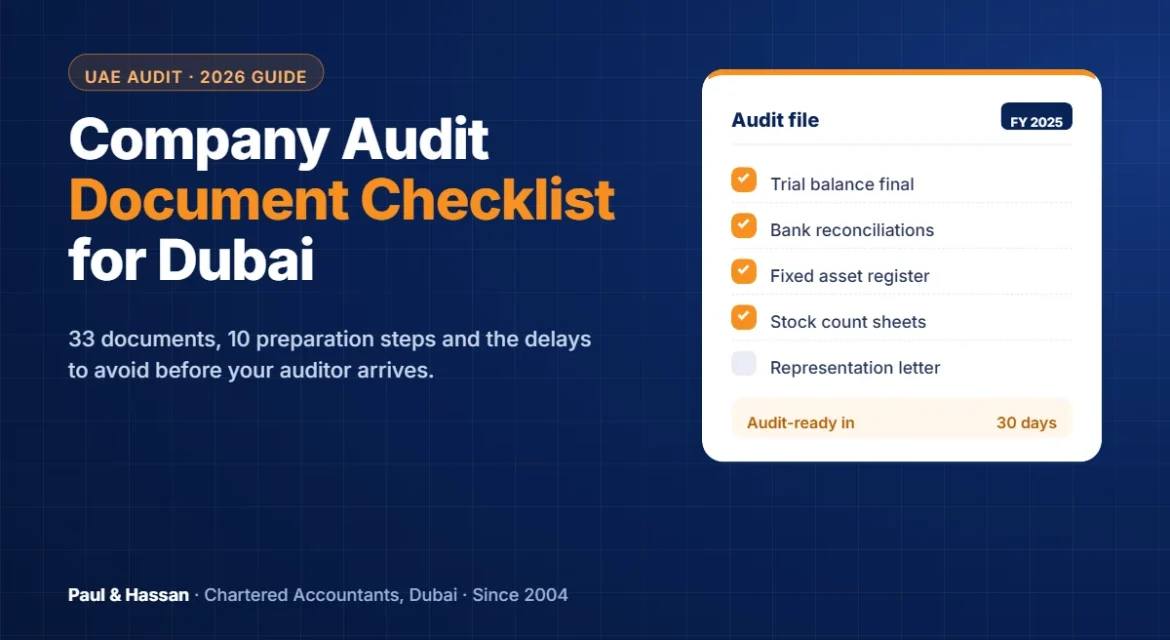
A complete company audit documents checklist Dubai businesses can follow: 33 documents to prepare, UAE audit requirements for small businesses, a 10-step audit preparation plan and the delays to avoid.
Audit season in Dubai rarely goes wrong because of the audit itself. It goes wrong because documents are missing, ledgers do not reconcile and nobody can find last year’s board resolution. This company audit documents checklist Dubai businesses can follow lists every record your auditor will ask for, explains when to prepare it and shows how to avoid the delays that push audits past licence renewal and tax deadlines.
Paul & Hassan Chartered Accountants has audited companies in the UAE since 2004, for mainland, free zone and group clients. The company audit documents checklist Dubai owners will find below reflects the rules in force in 2026, including the corporate tax requirements for audited financial statements that apply to financial years starting on or after 1 January 2025.
Key takeaways from this company audit documents checklist Dubai guide
- Mainland LLCs and most free zone companies need audited financial statements every year, prepared under IFRS by a licensed, approved auditor.
- For corporate tax, audited statements are required if revenue exceeds AED 50 million, for Qualifying Free Zone Persons, and for all tax groups.
- Prepare 33 core documents across six groups: corporate, financial records, bank, revenue and payables, assets, and payroll and tax.
- Start within 30 days of your year end. Most delays come from unreconciled bank accounts, missing contracts and unsupported balances.
- Keep accounting records for at least five years, and corporate tax records for seven years.
Table of Contents
UAE Company Audit Requirements for Small Businesses
Before you build an audit file, confirm why your company is being audited. The UAE company audit requirements for small businesses depend on where the company is licensed, its legal form and, since corporate tax, its revenue and tax status. The table summarises the position most Dubai businesses face.
| Business type | Is an annual audit needed? |
|---|---|
| Mainland LLC (Dubai DET licence) | Yes. The Commercial Companies Law requires LLCs to appoint an auditor and prepare annual financial statements audited by a firm licensed in the UAE. |
| Free zone company (DMCC, JAFZA, DAFZA, RAKEZ and others) | Usually yes. Most free zones require audited accounts from an approved auditor to renew the licence. Check your authority’s current rules and deadline. |
| Branch of a foreign company | Generally yes, for the UAE branch’s own activities, as part of licence renewal. |
| Corporate tax: revenue above AED 50 million | Yes. Audited financial statements must be prepared and maintained for corporate tax purposes. |
| Corporate tax: Qualifying Free Zone Person | Yes, regardless of revenue, to benefit from the 0% rate on qualifying income. |
| Corporate tax group | Yes. From financial years starting on or after 1 January 2025, tax groups prepare audited special purpose aggregated financial statements. |
Even when the law does not strictly require an audit, banks, investors and government tenders often ask for audited accounts. That is why the UAE company audit requirements for small businesses should be checked at the start of every financial year, not when the licence is about to expire. Our audit and assurance team can confirm what applies to your company.
When to Start: A Practical Audit Timeline
A smooth audit begins long before the auditor arrives. Use this timeline for a 31 December year end, and shift the months if your financial year ends on a different date.
| Timing | What should happen |
|---|---|
| Before year end | Agree the audit plan, fees and timeline with your auditor. Book the stock count date. |
| Year end (31 Dec) | Count inventory and cash. Request bank confirmations. Cut off sales and purchases. |
| Within 30 days | Close the books, reconcile every bank account and produce the trial balance. |
| Days 30 to 60 | Share the audit documents and answer the auditor’s first queries. |
| Days 60 to 90 | Audit fieldwork, testing and review of adjustments. |
| Days 90 to 120 | Draft financial statements, management representation letter and signed audit report. |
| Within 9 months | File the corporate tax return, which relies on the final, audited figures. |
Free zones often link audited accounts to licence renewal, so work back from your renewal date as well, and add both dates to your audit preparation checklist Dubai plan. Starting with the company audit documents checklist Dubai teams use in the first month after year end removes most of the pressure later.
Company Audit Documents Checklist Dubai: 33 Documents to Prepare
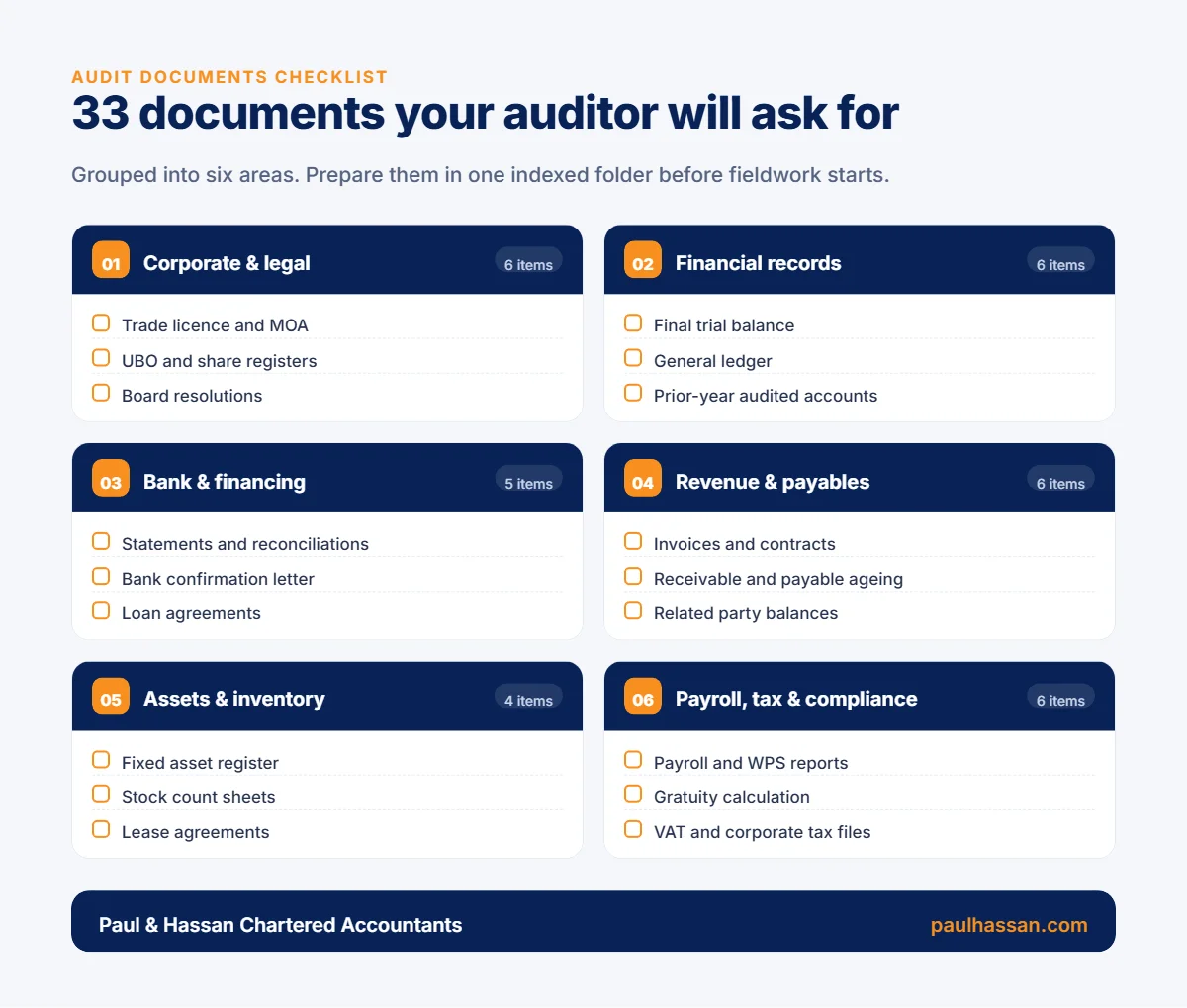
This is the core of the guide. Gather these documents into one shared folder, named and indexed by group, before fieldwork starts. Auditors will still have follow-up questions, but a complete company audit documents checklist Dubai file can cut the audit time in half.
Corporate and legal documents
6 items- Trade licence for the year, and any renewals
- Memorandum and Articles of Association, with all amendments
- Share register and share certificates
- Ultimate Beneficial Owner (UBO) register
- Board and shareholder resolutions for the year
- Manager appointment, powers of attorney and authorised signatories
Financial records
6 items- Final trial balance at year end
- General ledger for the full year
- Previous year’s audited financial statements
- Chart of accounts and journal listing
- Monthly or quarterly management accounts
- List of adjusting and closing entries
Bank, cash and financing
5 items- Bank statements for every account, for the full year
- Year-end bank reconciliations
- Signed authority letter for bank confirmations
- Loan, overdraft and facility agreements with repayment schedules
- Petty cash count sheet at year end
Revenue, receivables and payables
6 items- Sales invoices, customer contracts and credit notes
- Receivables ageing report and customer statements
- Purchase invoices and supplier contracts
- Payables ageing report and supplier statements
- Related party transactions and balances, with agreements
- Post-dated cheques issued and received
Assets and inventory
4 items- Fixed asset register with purchase invoices
- Depreciation schedule and disposal records
- Inventory count sheets and valuation workings
- Lease agreements for offices, warehouses and vehicles
Payroll, tax and compliance
6 items- Payroll registers and WPS salary transfer reports
- Employee contracts and end-of-service gratuity calculation
- VAT returns, payment receipts and FTA correspondence
- Corporate tax registration and tax computation
- Insurance policies
- Details of legal cases, claims and guarantees
Not every company needs every item. A service business without stock can skip inventory counts, and a company without borrowings will not have facility agreements. If a document does not apply, tell your auditor at the start, so the request list stays focused. Everything else on this list is among the documents required for company audit UAE auditors request in almost every engagement.
Documents Required for Company Audit UAE by Business Type
The core list above applies to almost every company. The documents required for company audit UAE auditors add on top depend on what your business does. Prepare these extra records if they apply to you.
| Business type | Additional documents auditors usually request |
|---|---|
| Trading and distribution | Customs import and export declarations, stock movement reports, slow-moving stock analysis, supplier rebate agreements. |
| Services and consultancy | Signed client engagement letters, timesheets, unbilled work and deferred revenue workings. |
| Contracting and fit-out | Project budgets, cost-to-complete estimates, progress certificates and retention balances. |
| Real estate | Title deeds, Oqood or Ejari records, tenancy contracts, valuation reports. |
| Free zone companies | Free zone licence renewal forms, approved auditor confirmation and any authority-specific declarations. |
| Groups and holding companies | Intercompany reconciliations, loan agreements between group entities and consolidation workings. |
Collecting the documents required for company audit UAE regulators and auditors expect for your sector early is the simplest way to avoid repeated requests. Trading companies, for example, should book their year-end stock count in advance, because a missed count is very hard to reconstruct.
Audit Preparation Checklist Dubai: 10 Steps Before the Auditor Arrives
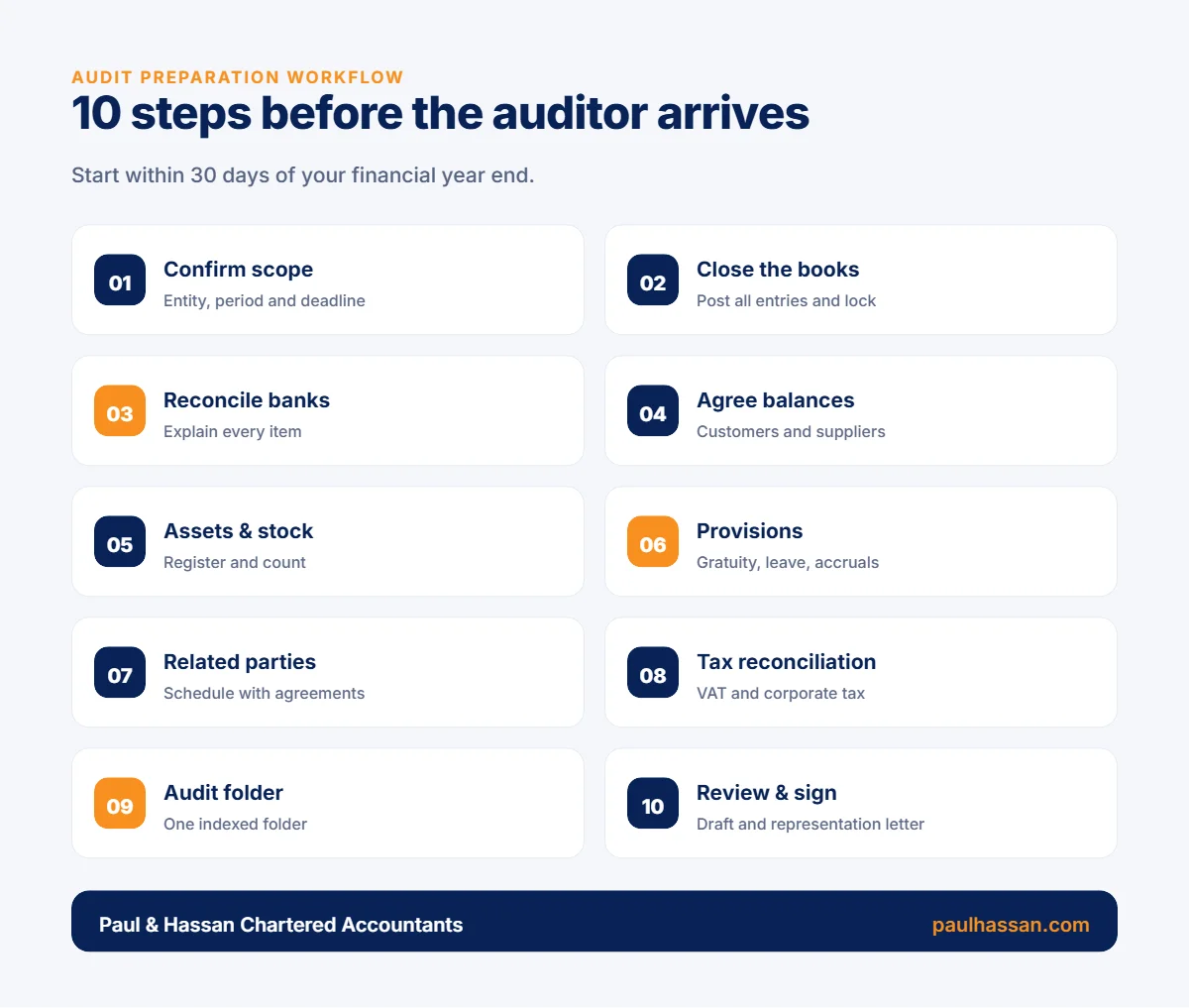
Documents alone do not make an audit smooth. Follow this audit preparation checklist Dubai finance teams use to turn a pile of records into an audit-ready file.
- 01
Confirm the audit scope and deadline
Agree with your auditor which entity, period and reporting framework are covered, and work back from your licence renewal and corporate tax deadlines.
- 02
Close the books for the year
Post every invoice, bill, accrual, prepayment and depreciation entry, then lock the period so figures stop changing.
- 03
Reconcile every bank account
Match each bank statement to the ledger at year end and explain every reconciling item. Unreconciled banks are the most common cause of audit delay.
- 04
Reconcile receivables and payables
Agree customer and supplier balances to statements, review old balances and decide whether any receivables need a provision.
- 05
Review fixed assets and inventory
Update the fixed asset register, record disposals, and reconcile the stock count to the ledger.
- 06
Calculate provisions and accruals
Recalculate end-of-service gratuity, staff leave, bonuses and any known liabilities at year end.
- 07
Prepare related party schedules
List every transaction and balance with shareholders, directors and group companies, with supporting agreements.
- 08
Reconcile VAT and corporate tax
Agree VAT returns to the ledger and prepare the draft corporate tax computation from the trial balance.
- 09
Organise the audit folder
Upload documents into one indexed folder that matches this company audit documents checklist Dubai list, and name a single contact person.
- 10
Review the draft and sign off
Review the draft financial statements and proposed adjustments, then sign the management representation letter.
Practical tip
Run the audit preparation checklist Dubai steps every quarter, not only at year end. Quarterly bank and balance sheet reconciliations mean the year-end close takes days instead of weeks.
What Your Auditor Will Test
Understanding what the auditor is looking for helps you prepare the right evidence. Knowing this makes your audit preparation checklist Dubai work far more targeted. Under International Standards on Auditing, the auditor gathers evidence that the financial statements are free from material misstatement. In practice, testing focuses on six questions.
| Audit test | What it means for you |
|---|---|
| Existence | Assets and balances are real. Expect bank confirmations, stock counts and customer confirmations. |
| Completeness | Nothing is missing. Expect searches for unrecorded liabilities and a review of payments after year end. |
| Accuracy | Amounts are recorded correctly. Expect sample checks of invoices against the ledger. |
| Cut-off | Transactions are in the right year. Expect checks on sales and purchases around the year end. |
| Valuation | Balances are measured correctly. Expect reviews of provisions, stock values and receivable recoverability. |
| Presentation | Disclosures follow IFRS. Expect review of notes, related parties and accounting policies. |
8 Common Audit Delays (and How to Avoid Them)
Most audits that run late in Dubai fail for the same handful of reasons. Each one is avoidable with the company audit documents checklist Dubai teams prepare early.
1. Unreconciled bank accounts
Reconcile monthly and explain every old reconciling item before year end.
2. Missing contracts and agreements
Keep signed customer, supplier, lease and loan agreements in one central folder.
3. Unsupported related party balances
Document shareholder and group balances with agreements and confirmations.
4. No year-end stock count
Book the count in advance and invite your auditor to attend.
5. Old receivables never reviewed
Review ageing quarterly and agree a provision policy for doubtful debts.
6. Gratuity not recalculated
Recalculate end-of-service benefits for every employee at year end.
7. Late bank confirmations
Sign the bank confirmation authority letter as soon as the auditor requests it.
8. Books kept only on spreadsheets
Move to proper accounting software, or ask for backlog accounting support before the audit.
IFRS and Reporting Rules to Know
UAE companies prepare financial statements under International Financial Reporting Standards (IFRS). For corporate tax purposes, a business with revenue of AED 50 million or less may use IFRS for SMEs, which is simpler and needs fewer disclosures. Auditors still test that your accounting policies are applied consistently from year to year, which is an often overlooked part of the UAE company audit requirements for small businesses.
Three standards cause most adjustments for small and medium-sized businesses: IFRS 15 for revenue from contracts, IFRS 16 for leases such as office and warehouse tenancies, and IFRS 9 for expected credit losses on receivables. If these are new to your team, our IFRS advisory service can review your policies before the audit starts.
How Long to Keep Audit Documents
Once the audit is signed, archive the full audit file, not just the final report. UAE rules set different minimum retention periods depending on the law.
| Record | Minimum retention period |
|---|---|
| Accounting books and supporting documents (company law) | At least 5 years from the end of the financial year |
| VAT records | At least 5 years after the end of the tax period |
| VAT records related to real estate | 15 years |
| Corporate tax records | 7 years after the end of the tax period |
Add archiving as the final line of your company audit documents checklist Dubai routine. Because corporate tax uses the longest general period, many businesses simply keep every audit document for seven years. Failing to keep required records can also lead to penalties from the Federal Tax Authority.
Quick Company Audit Documents Checklist Dubai (Save This)
Use this condensed company audit documents checklist Dubai teams can print or copy into a task manager before every audit.
- Audit scope, auditor and deadline agreed
- Trade licence, MOA and UBO register ready
- Board and shareholder resolutions filed
- Books closed and trial balance final
- All bank accounts reconciled
- Bank confirmation letter signed
- Receivables and payables agreed to statements
- Fixed asset register updated
- Stock count completed and reconciled
- Gratuity and accruals recalculated
- Related party schedule prepared
- VAT and corporate tax reconciled
How Paul & Hassan Supports Your Audit
Paul & Hassan Chartered Accountants is registered with the UAE Ministry of Economy as auditors and has supported businesses in Dubai since 2004. We provide external and statutory audits, financial statement audits and internal audit, and we can help you prepare an audit-ready file through our bookkeeping services. We also align your audited figures with your corporate tax return.
Preparing for your next audit?
Share your trial balance and we will review it against this company audit documents checklist Dubai list and give you a clear audit plan and quote.
Frequently Asked Questions
Answers to the questions Dubai business owners ask us most often about audits and this company audit documents checklist Dubai guide, in two parts: audit requirements and timing, then documents, preparation and costs.
Part 1 Audit Requirements and Timing
Is an audit mandatory for every company in Dubai?
Not every business, but most. Mainland LLCs must have their annual financial statements audited under the Commercial Companies Law, and most free zones require audited accounts to renew the licence. Corporate tax adds further audit requirements for larger businesses, Qualifying Free Zone Persons and tax groups.
What are the UAE company audit requirements for small businesses?
The UAE company audit requirements for small businesses depend on legal form and licence. A small mainland LLC still needs an annual audit, while a free zone company should follow its authority’s renewal rules. For corporate tax, audited statements are required when revenue exceeds AED 50 million or the company claims Qualifying Free Zone Person status.
When do audited financial statements have to be ready?
There is no single national deadline. Free zones usually link audited accounts to licence renewal, and the corporate tax return is due within nine months of the end of the tax period. In practice, most companies aim to finish the audit within three to four months of year end.
Does corporate tax require audited financial statements?
Yes, in some cases. Under Ministerial Decision No. 84 of 2025, audited financial statements are required for taxable persons with revenue above AED 50 million, for Qualifying Free Zone Persons, and for tax groups, which prepare audited special purpose aggregated statements.
Who can audit a company in the UAE?
The auditor must be licensed to practise in the UAE and registered with the Ministry of Economy. Many free zones also keep their own list of approved auditors, so check that your auditor is approved by your free zone before you appoint them.
Do free zone companies need an audit?
Most do. Authorities such as DMCC and JAFZA require audited financial statements as part of licence renewal, and requirements vary between free zones. A Qualifying Free Zone Person must also maintain audited statements for corporate tax.
How long does a company audit take?
For a small or medium-sized company with organised records, fieldwork usually takes one to three weeks, and the full process from document request to signed report often takes four to eight weeks. A complete company audit documents checklist Dubai file is the biggest factor in keeping it short.
Can a dormant company skip the audit?
Not automatically. A dormant company may still need audited or reviewed accounts to renew its licence, depending on the licensing authority. Confirm the requirement with your authority before the renewal date.
What reporting standards apply to audited accounts in the UAE?
Financial statements are prepared under International Financial Reporting Standards. For corporate tax purposes, businesses with revenue of AED 50 million or less may use IFRS for SMEs.
What happens if my company does not get audited?
You may be unable to renew your trade licence, open or keep bank facilities, or support your corporate tax return. Authorities can also impose penalties for failing to keep proper accounts.
Part 2 Documents, Preparation and Costs
What documents are required for a company audit in the UAE?
The core documents required for company audit UAE auditors request are the trade licence, MOA, UBO register, resolutions, trial balance, general ledger, bank statements and reconciliations, sales and purchase records, fixed asset register, inventory counts, payroll records, VAT returns and corporate tax workings.
What should an audit preparation checklist Dubai companies use include?
A complete audit preparation checklist Dubai companies can rely on covers agreeing the scope and deadline, closing the books, reconciling banks, receivables and payables, updating fixed assets and inventory, recalculating provisions, preparing related party schedules, reconciling taxes and organising one indexed audit folder.
How do I prepare for my first audit?
Start by organising your books for the full year, reconciling every bank account and collecting your legal documents. If your records are incomplete, ask an accountant to bring them up to date before you appoint the auditor.
Why does my auditor need bank confirmations?
Bank confirmations are independent evidence of your balances, loans and guarantees at year end. The auditor sends a request directly to the bank, which is why you need to sign an authority letter early.
What are related party transactions?
They are transactions with shareholders, directors, their families or group companies, such as loans, shared expenses or sales. Auditors must review and disclose them, so prepare a schedule with supporting agreements.
Do I need a stock count at year end?
If your company holds inventory, yes. A physical count at or near year end, ideally attended by the auditor, is the main evidence that the stock in your accounts exists and is valued correctly.
How is end-of-service gratuity treated in the audit?
The auditor checks that the year-end provision covers every employee’s entitlement under UAE labour law and their contract. Prepare an employee-by-employee calculation with joining dates and basic salaries.
Can the auditor also prepare my accounts?
Independence rules limit how much bookkeeping your own auditor can do. Many companies use one firm for bookkeeping and another for the audit, or use separate teams with appropriate safeguards.
How much does a company audit cost in Dubai?
Fees depend on the size and complexity of the business, the number of transactions, the quality of the records and the deadline. Request a quote based on your trial balance, and expect lower fees when your company audit documents checklist Dubai file is complete.
How long should I keep audit documents?
Keep accounting records for at least five years under company law, and corporate tax records for seven years after the end of the tax period. Many businesses keep the full audit file for seven years.
This article is general information based on UAE company law and corporate tax rules as of October 2026 and is not audit, legal or tax advice for your specific situation. Free zone rules and deadlines differ by authority, so confirm current requirements with your licensing authority, the Federal Tax Authority or a qualified adviser.